
The more I pursue my interest in executive coaching, the more I realise how deceptively simple a good question can be. When asked casually, it might elicit little more than a shrug. But when framed with care, it can unearth important realisations. And when asked with precision and purpose, it can shift the course of a conversation, or even a young person’s sense of themselves.
In a recent article on generative thinking and questioning (complete with a free downloadable resource), I explored how better classroom questions can prompt deeper thought, nudging students to reflect, connect, and stretch their understanding.
The quality of these questions matters because they shape the climate in which learning and behaviour unfold. Crucially, they also communicate, implicitly or otherwise, what we believe our students are capable of.
This article, then, explores how reflective, purpose-driven, coaching-style questions can be adapted for both academic and pastoral contexts to help students develop greater self-awareness, self-regulation, and metacognition, so that they are more likely to become agents of their own improvement.
Structure vs Empathy?
Before diving into practical examples, it’s worth acknowledging a live tension in contemporary education between two schools of thought. Both seek to improve behaviour and relationships in schools, but they follow different paths and apply different priorities.
In When the Adults Change, Everything Changes, Paul Dix highlights relational repair, empathy, and consistency. He champions the importance of warm adult behaviour, restorative conversations, and upholding dignity for all. In his view, effective behaviour management is as much about emotional intelligence as it is about consequences.
By contrast, Tom Bennett, in Creating a Culture, argues for clarity, predictability, and institutional backbone. He warns against what he terms the “counsellorfication” of the profession, when schools rely too heavily on fluffy (my characterisation) dialogue without first establishing firm boundaries and strong routines. Warmth without structure, Bennett suggests, is not kindness but a catalyst for chaos.
It is my firm belief that these perspectives are not oppositional but complementary. Together, they offer two essential lenses for every school senior leadership team: the calm authority of Bennett’s structural approach and the empathetic curiosity of Dix’s relational one. Both are needed, on balance, for school policies and cultures that benefit from clarity, consistency, and empathy.
Same Compass, Different Paths
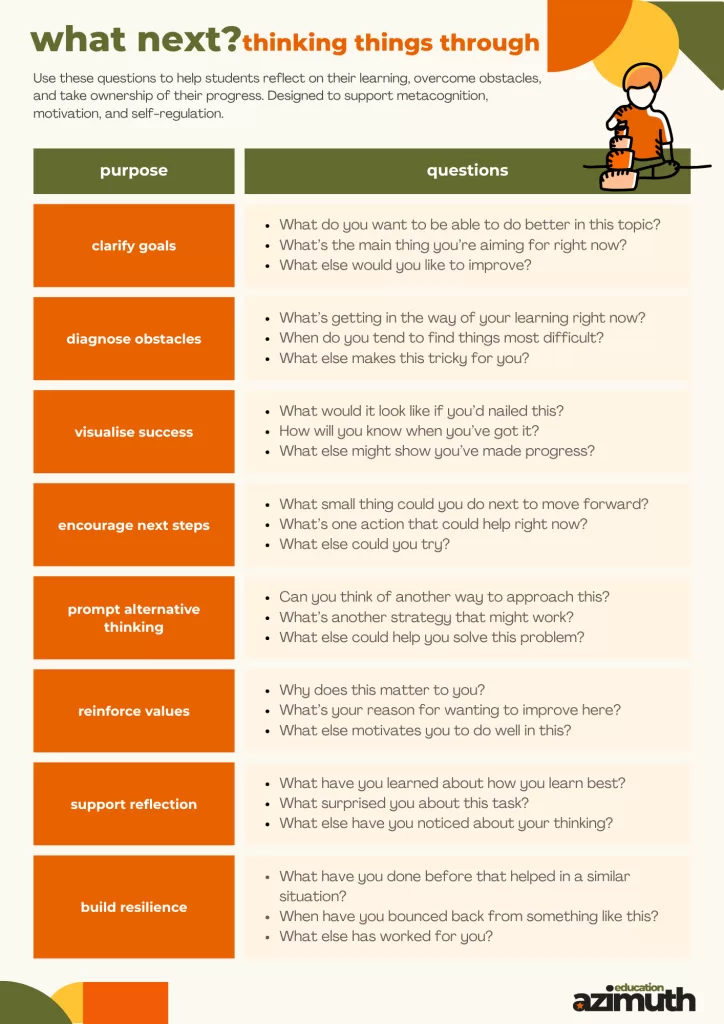
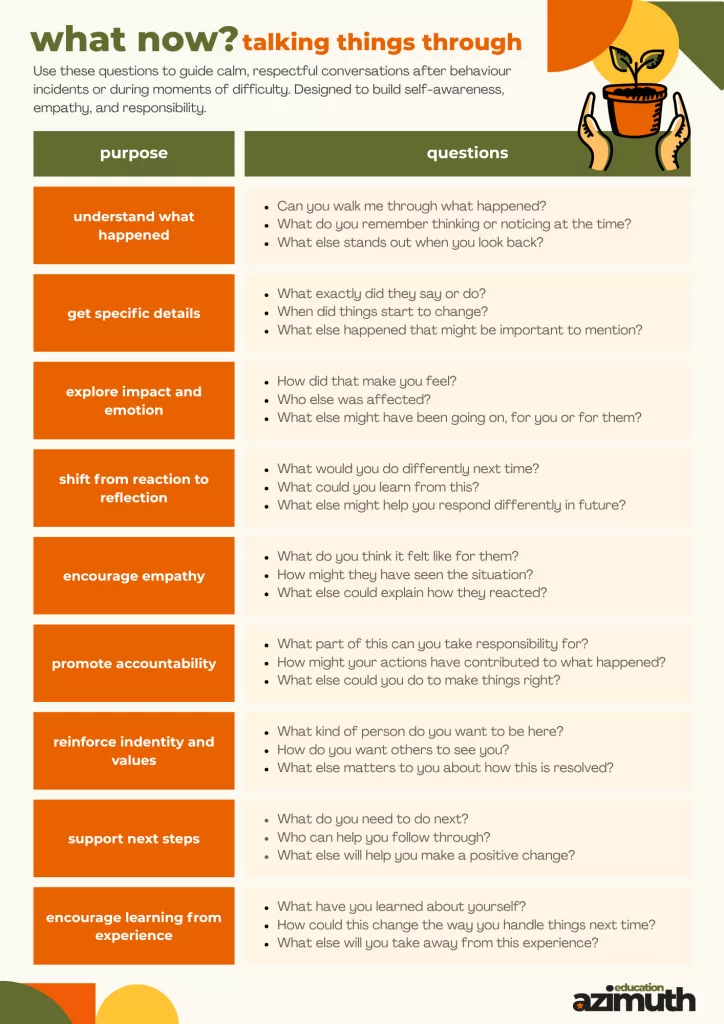
With that in mind, here are two adapted sets of questions inspired by the coaching approach and by the work of the giants upon whose shoulders I stand: one for academic progress and classroom learning, the other for pastoral conversations and behaviour reflection. Each set of questions is designed to promote metacognition, self-regulation, and perspective-taking.
What Next? Thinking Things Through
What Now? Talking Things Through
What else?
Notice the inclusion of “what else” questions. These questions may seem simple, but they are among the most powerful tools in a teacher’s repertoire, because they gently signal that the first response is not the final word, and that thinking can and should go further than the surface. True insight often lies just beyond the initial answer.
By inviting elaboration, these questions unlock deeper reflection and encourage reflective thinking by allowing students the space to think. To be clear, these questions should follow clear policies and interventions, not replace them. As with most things on this website, they are a compass, not a map.
Towards a reflective culture
Good questioning is a craft: a discipline that can be practised, embedded, and improved. This is great news for those of us who are not naturals or innately skilled at it. But first, we need to establish clarity of intent (policy) and respect for each other (culture). Whether used in classrooms to support learning or in pastoral contexts, well-framed questions help create the conditions for thinking, not just compliance.
We need not choose between structure and empathy. Instead, let us model for our students the very synthesis we seek: rigour with care; reflection and responsibility.
References and Further Reading
Bennett, T., 2017. Creating a culture: How school leaders can optimise behaviour. London: Department for Education.
Dix, P., 2017. When the adults change, everything changes: Seismic shifts in school behaviour. Bancyfelin: Crown House Publishing.
Education Endowment Foundation (EEF), 2018. Metacognition and self-regulated learning: Guidance report. London: EEF.
Goleman, D., 1996. Emotional intelligence: Why it can matter more than IQ. London: Bloomsbury.
Starr, J., 2021. The coaching manual: The definitive guide to the process, principles and skills of personal coaching. 5th ed. Harlow: Pearson Education.
Wiliam, D., 2016. Leadership for teacher learning: Creating a culture where all teachers improve so that all students succeed. West Palm Beach: Learning Sciences International.
“We do not learn from experience… we learn from reflecting on experience.”
John Dewey
Photo by Monstera Production

Comments
Loading comments…