

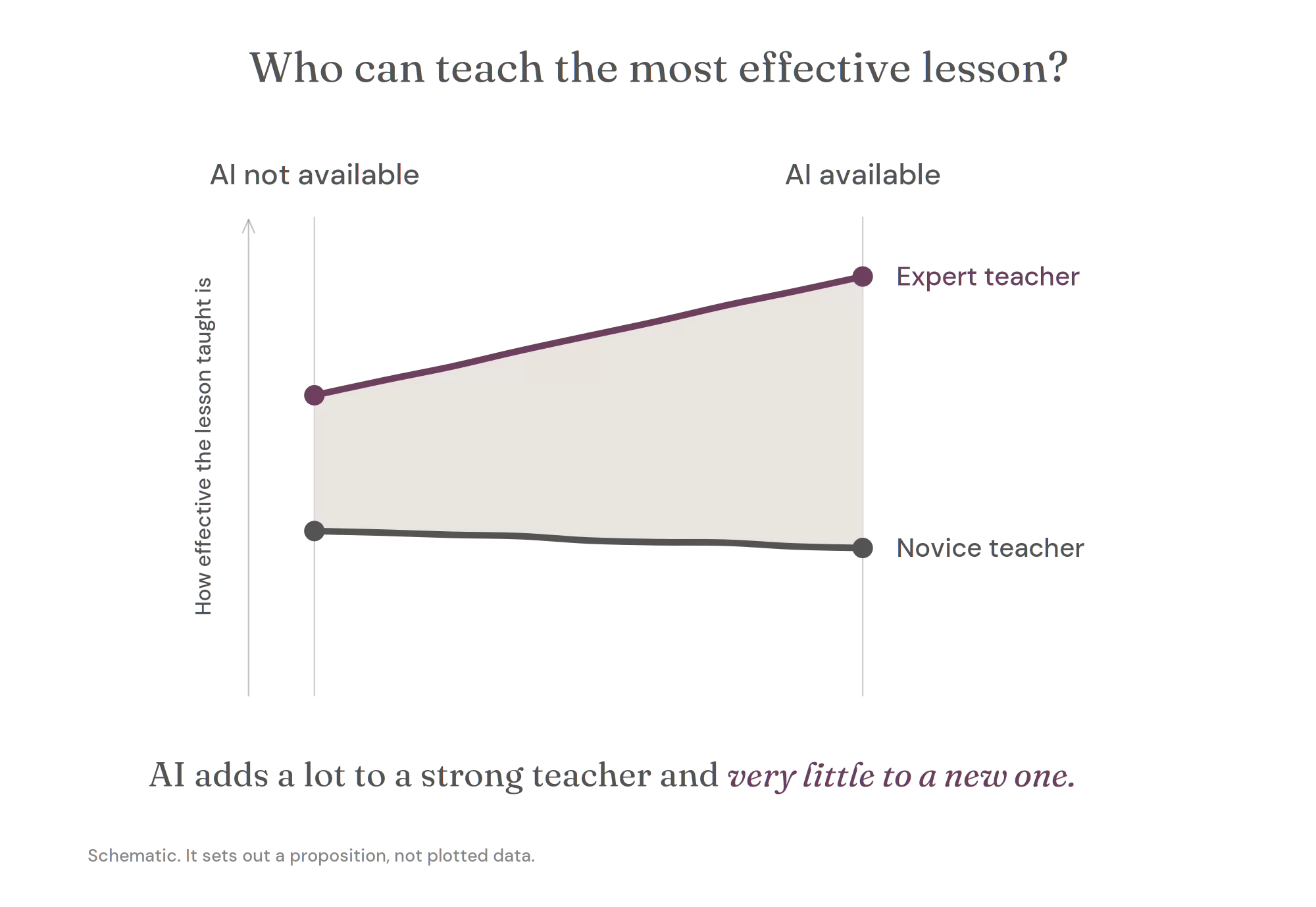
A headteacher told me recently that AI was going to make his staff more efficient. His reasoning was sound enough. Teachers could now get planning support, resources, feedback, differentiation, all of it. Workload issues would be solved. And, to boot, the ones who needed it most would gain the most, because the strong teachers were already strong. Over time, he argued, the distance between them would close.
I said I wasn’t so sure, and that I thought AI added value rather than efficiency: the two are not the same thing.
He asked me what the difference was, so I asked him a different question. If the school needed a new website, who would produce the better one: someone who has never written a line of code but has AI, or a website developer with the same AI?
He paused. Then he gave the answer everyone gives. You have already answered it too.
What we are being sold
He is not an outlier. If you look at what schools are currently offered by way of AI training, you will see the same assumption everywhere. Sessions on prompting. Tours of the tools. Workshops built around a platform rather than around teaching. The market has taken schools at their word: the skill in question is operating the software.
And the offer is about to get much harder to refuse. In July, Anthropic launched Claude for Teachers, free for verified K-12 educators in the United States, with curriculum resources mapped to the academic standards of all fifty states. It joins equivalent products from Google, OpenAI and Khan Academy. This is not available in the UK yet, but something comparable is likely to be on offer on this side of the pond soon enough.
Anthropic says a lesson plan can be assembled overnight from current data, arriving complete on a teacher’s desk in the morning. Whether that is the best thing to happen to a school in a decade or a slow puncture in teacher expertise depends on who is at the receiving end of the lesson plan.
Asking the wrong question
Here is the shift in thinking I would suggest to school leaders. Stop asking what AI does for a teacher. Ask what it does to the gap between teachers, because the spread of expertise across a staff body is more a leadership matter in a way that an individual teacher’s use of a tool is not.
And once you ask it that way, the answer to the website question starts to look uncomfortable. If the developer produces the better site, then the same tool in two pairs of hands produces two very different outcomes. What separates them is expertise.
Why the gap opens
Three things are happening, and they compound.
You can only ask for what you know exists. An experienced teacher asks the AI for the misconceptions pupils typically bring to this topic, a retrieval starter interleaving what was covered last term, a worked example pitched at the various ability levels within her set. A novice teacher just asks for a lesson on ionic bonding. Both get what they asked for, but only one of them knew what to ask.
You can only use what you can judge. This is the one that, in my view, matters most. What comes back is limited less by what the AI can generate than by the reader’s ability to tell whether it is any good. The experienced teacher sees that every practice question sits at the same shallow level. The newer teacher sees something that looks like every lesson plan they have ever been given, because it probably does. Plausibility is the trap, and subject and pedagogical knowledge are what allow you to spot it.
What you hand over depends on what you value. The expert hands over production and keeps design. They will delegate the typing, the formatting, the first pass at a worksheet. They will not delegate the decision about what the lesson is for. The novice hands over design, because design is the hard part, and they cannot yet tell that the hard part is the valuable part.
The plan was never the point
However, teaching happens in the room rather than in a lesson plan. Teaching means departing from the plan, because the misconception that surfaces in minute nine was not in the document and could not have been foreseen. Expert teachers know implicitly that every good lesson is a series of small decisions about what to abandon and what to protect.
A plan you did not build is a plan you cannot safely depart from, because you do not know which parts were load-bearing.
That moment of departure, when the lesson wobbles and a teacher has to decide what to do about it, is how a novice gets on the path to expertise. It is their productive struggle. We accept this readily for children. We would not dream of handing a pupil the answer and calling it learning. We seem to be considerably less careful about the adults.
A sufficiently good plan, arriving fully formed, removes that struggle. The plan seems better than anything they could have written on their own, and the difficulty that would have taught them how to plan has gone with it.
The rungs that automate first
My partner heads procurement for a large insurance company. She has been worrying about something that has nothing to do with schools.
The tasks AI now handles well in her industry are the tasks you hand to people who have just arrived. Checking a schedule of terms. Assessing claims. Comparing tenders against each other. That work looked like a cost, but it turns out it was an investment. You got better at the job by doing it.
I have heard the same from friends who practise law. Disclosure. Document review. First drafts. Tedious, for sure, but also the way a trainee becomes a solicitor.
Several professions seem to be arriving at this at once. The bottom rungs of the ladder were doing more than we credited them with, and they are the rungs that AI is trying to automate first.
Which raises the obvious question. If expertise is what makes AI worth having, can AI build that expertise faster?
Partly, I think, and that is probably a good thing. It is genuinely useful for the parts of expertise that come from knowledge. Subject content. Worked examples of strong practice. Banks of common misconceptions. A new teacher with a good subject lead and a good tool will build knowledge faster than one with neither.
It can do much less for the part that is judgement, because judgement is built by consequence. You learn which parts of a lesson were holding it up by experiencing one fail in front of thirty children and working out why. There is no route through that which avoids the failing, because the failing is the point.
Efficiency and value
Which brings me back to the headteacher’s question, and to what he was measuring.
Efficiency asks how much time it saved. Value asks how much better the lesson was.
Look at how the sector reports on this and you can see which one has won. An American study found that six in ten teachers had used an AI tool for work, and that the three in ten using one weekly estimated they were saving close to six hours a week. That is the figure that gets plastered on every blog and PowerPoint slide. I have yet to see a headline about whether the lessons were any better.
Efficiency wins by default because it is easy to count. You can put hours saved in a report to governors. You cannot put “the lesson was better than it would otherwise have been” in a report to governors, even though it is arguably the only thing that matters.
The two lead to different spending. A school buying efficiency provisions tools and trains people on tools, then measures success by adoption. A school buying value spends comparable money on the expertise that turns a tool into better teaching, and on the mentoring that gets people there faster.
The tools are, in the end, the cheap part.
We already know this
The headteacher did not need persuading about websites. He knew instantly that the developer would produce the better one, and he knew precisely why. That knowledge was there the whole time. It had simply never been pointed at the teaching.
We understand perfectly well, in every other domain, that a powerful tool in expert hands produces something a novice cannot match with the same tool. We understand it about surgery. We understand it about law.
We know it about teaching too. We just have not yet been asked the question in a way that lets us notice.
Featured image by Lazarescu Alexandra on Unsplash
Who is doing the thinking?
It is the question I keep coming back to. So I have written a short briefing around it.
Who Is Doing the Thinking? sets out a bearing to guide school leaders’ thinking on AI, whatever the technology does next, with two practical tools: a six-question self-check to take to your senior team, and six moves for next term.