

Before the pandemic, at the Bryanston Education Summit, I found myself somewhat implausibly sitting next to Dylan Wiliam in the green room. He was a keynote speaker that day; I was there to run a graveyard shift elective. His books and his talks had shaped how I thought about teaching more than almost anyone’s, so sitting beside him was daunting. He looked, I remember thinking, like a cross between a Bond villain and a Caribbean pirate: the bald head, the pendant earring, the goatee, a confident, unbothered calm. He was very kind, and I remember being so star-struck I was barely being able to articulate a coherent sentence.
I told him what my session was about. One-to-one tablets, and how a well-run device programme could support teaching and learning. He listened patiently. If there was scepticism in his expression, it was the mild kind, the look of someone hearing a familiar phrase and reserving judgement.
The harder scepticism that day came from elsewhere, and I had met it many times by then. Other people were certain the evidence said tablets were a distraction, that children deserved better than being fobbed off with games and videos. What they pictured so vividly bore little resemblance to our classrooms, where the devices were managed, the available apps were there for a reason, and teachers and pupils had been shown how to use them well. So my answer was always the same. We must be doing something wrong, then, because in our school they worked, really rather well, and I had the evidence to show it. Usually that was where the conversation ended, as the work of shifting a settled belief is greater than the work of changing the subject.
That brief exchange has stayed with me, and a recent episode of Craig Barton’s Mr Barton Maths podcast, an interview with Dylan Wiliam, brought it back. The real question in that green room was never whether the research endorsed the tool. It was whether we were willing to decide with the evidence we had, including what our teachers knew about their own pupils.
When there is no evidence
The same question is being asked again now, about AI, and a good number of school leaders have settled on an answer. There is no solid evidence that AI helps children learn, the reasoning goes, so the responsible course is to keep it out. It sounds careful, and it has the ring of evidence-informed practice.
Listen to that podcast, though, and the picture complicates. Dylan Wiliam, who has done more than most to put evidence at the centre of how we talk about teaching, says plainly that if he were in the classroom today he would be experimenting with these tools. The caution and the urge to try exist in the same person at the same time, and he does not pretend to have resolved that conflict.
Wiliam is not handing anyone permission here. If the tension is real even for him, then it is real for all of us, and pretending otherwise is not helpful. It also exposes something about the confident position that doesn’t sit well with me. There is no firm evidence that AI helps or harms. A ban, then, cannot then be called evidence-informed, because there is nothing on either side of the scale. It may be caution-informed, but it’s not evidence-informed.
There is a cost to the wall, too. Tell a school that AI is forbidden and you do not make it disappear. You just drive it underground (see mobile phone bans, social media bans…). Pupils and staff use these tools anyway, unsupervised, on personal accounts, beyond anyone’s sight or help. And not all of them equally: the pupils with a subscription at home grow fluent in private, while the ones without are the only ones a ban actually stops. The wall does not close the gap. It widens it. The moral high ground turns out to be a place where children are less safe and the chance to learn together, in the open, has been thrown away.
What school is for
The objection deserves a fair hearing, because the people making it worry, reasonably, about the effect of a powerful new technology on young minds we do not fully understand. And there is a neat trap inside the worry. We cannot use AI responsibly until we know more about it. We cannot know more about it unless we use it. So here we are.
”Caution is the method, not the excuse.
Think about what school is for. A great deal of it is learning to act under uncertainty, to take what you know and apply it in a situation you have not met before. If that is the work, then teachers modelling careful, supervised experimentation are doing the job, not betraying it. We already know how to bring an unknown into a school safely. We invite outside speakers, trial new resources and take children off site, and each time we follow a process that manages the risk. AI is not a deity to be feared or worshipped. It is an algorithm that can help or hinder teachers and pupils alike, and the task is to find out which is happening, under what conditions, with the guardrails that keep children safe throughout.
What previous tech deployments have taught us
The tablet years showed us how this looks in practice. We had no certainty when we started. What we had was a way of paying attention. We ran surveys, talked to teachers, pupils and parents, and watched our outcomes closely. Plenty else was changing in the school at the same time, so we never claimed the tablets caused our results to improve. What we could say with confidence was that introducing them did not stop us posting the best examination results in the school’s history five years later. No researcher would call that perfect evidence. I get that. But it was real evidence, gathered in context, and good enough to keep making sensible decisions. Had we held out for perfect, we would have let it become the enemy of the good, which in a school means years spent waiting while the world moves on.
The more useful lesson was about where to put our energy. The temptation was to train everyone to use the tablets. We did of course give staff the basics, how to switch the things on and find their way around them, but then spent the bulk of our time on something else entirely. We helped teachers teach better. Rosenshine, the Education Endowment Foundation, the Sutton Trust: we built a development programme around good teaching rather than around a device. Nobody was expected to deliver a tablet lesson. They were expected to deliver lessons, and then they were trusted, as professionals, to judge when a tablet would help whom in a lesson and when it would not.
I know that a managed tablet and a generative model are not the same problem, and it would be glib to pretend they were. A device estate is more of a closed container; the apps there for a reason. A large langauge model is open-ended, and can produce something unhelpful, or worse, on any subject at any moment. But that openness is the reason the judgement has to sit with a teacher rather than a policy.
That trust only works if it rests on knowledge. You cannot make good decisions about something you do not understand. If we want teachers and pupils to use AI well, they have to learn how it behaves: where it is strong, where it falls down, why the first answer it offers is so rarely the best one. They need the practical knowledge that comes from iterating, refining, and learning to make the tool argue back rather than agree with everything they say. The danger Wiliam keeps returning to in that conversation with Mr Barton is that the machine ends up doing the thinking. He is right, and that is exactly the point. Never hand to AI the thing you want to get better at, because you are the one who needs the practice, not the machine. Knowing what to delegate, and what to protect, is itself a skill, and it cannot be learned from behind a wall. Not all opinions are born equal. Offering an opinion on AI in schools without having used it in schools is a little like me offering advice on neurosurgery or quantum mechanics.
The walled garden
The better picture is a walled garden. The wall still stands and safeguarding still comes first, but inside it supervised play is allowed: the enthusiasts experiment in their sandboxes, and the rest of us learn from what they find, good and bad.
A walled garden has walls. Staff accounts rather than children’s, a short list of approved tools rather than the open web, a named owner, and the same logging and review you would give any new system that touches pupils. That is not exotic. It is the governance schools already run, pointed at something new. What supervised means shifts with age, of course. A sixth-form essay tool and a Year 2 classroom are different propositions, and the younger the pupils, the heavier the mediation.
Many heads are closer to this than they realise. There is often an interested teacher running some sort of AI club on a Tuesday afternoon, or a keen head of department leading a working group, and that instinct is a sound one.
The danger is mistaking it for a strategy. A policy on the website and an after school club is a start, and no more than that. The work is to make it intentional, to gather what those early experiments are teaching you, and to build the professional judgement that no external study can hand you. When the research is silent, that judgement is the best guide a school has. Waiting for it to arrive complete is waiting for something that may never come.
Which brings me back to the podcast, and to Dylan Wiliam suggesting that he, of all people, would certainly be in the experimenting camp if he were a teacher now. On reflection, the decision in front of school leaders begins to look different. The question stops being whether to be cautious and becomes how. A head who answers it, who builds the garden and tends it, stops waiting for someone else’s research to make the call and becomes the agent of the decision. The evidence may take years to arrive. The children are in front of us this term.
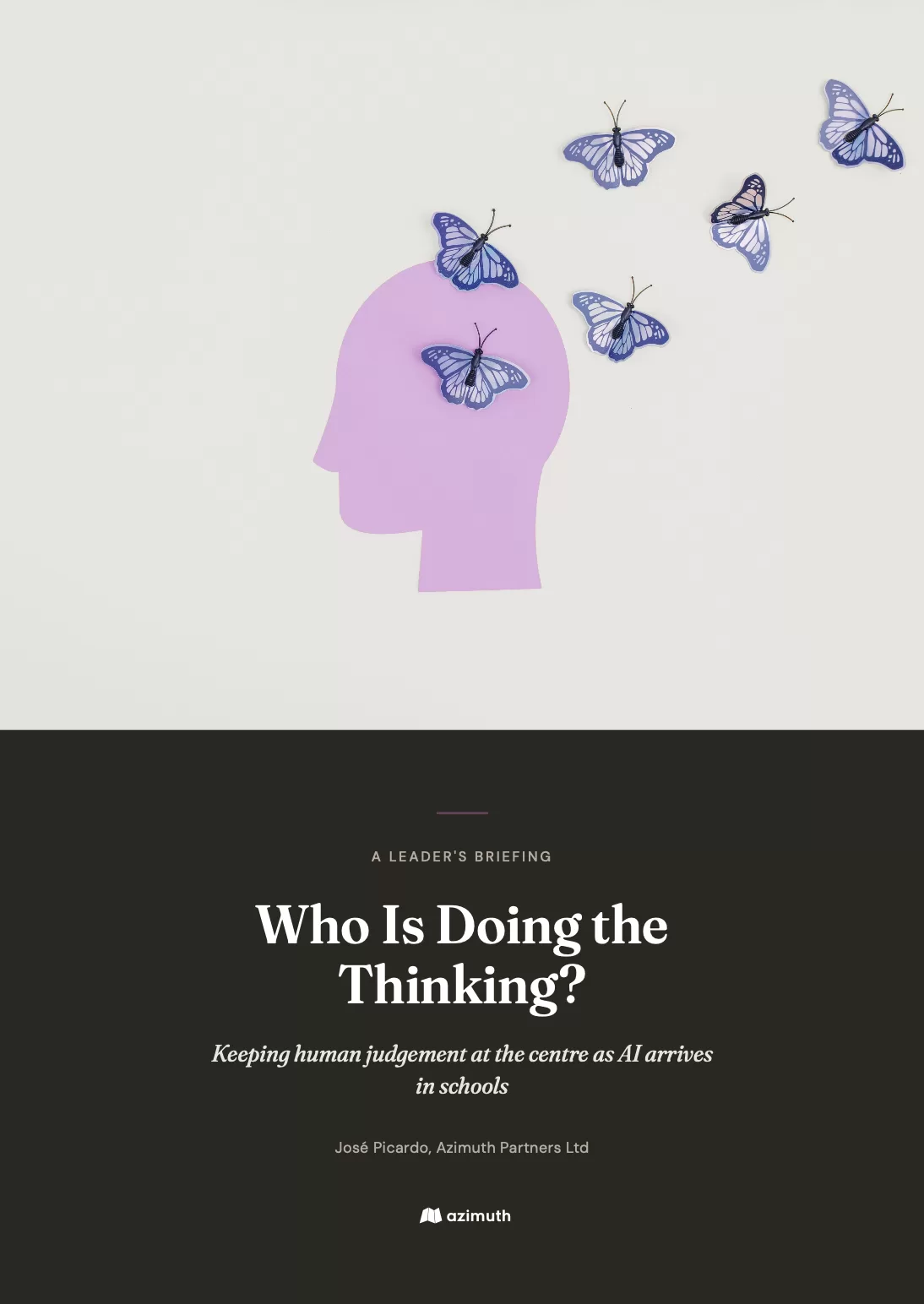
Who is doing the thinking?
It is the question I keep coming back to. So I have written a short briefing around it.
Who Is Doing the Thinking? sets out a bearing to guide school leaders’ thinking on AI, whatever the technology does next, with two practical tools: a six-question self-check to take to your senior team, and six moves for next term.
Photo by Quang Nguyen Vinh