

The 2026 Keeping Children Safe in Education was published yesterday. This year the document has changed in a samll but consequential way. Although it doesn’t have a section of its own (that’s a good thing), AI is in it.
The 4Cs of online risk now name generative AI directly. Deepfakes and “deep nudes” appear in the definitions of nude and semi-nude images. Filtering and monitoring must be reviewed at least once every academic year, owned by a named senior leader, and that filtering now has to reach the generative AI tools schools are buying. From 1 September 2026, this is statutory.
The tempting response is to treat it as a checklist. Update the policy. Name the lead. Log the review. Sign the register after INSET. And KCSIE does read like a list you can complete, which I think is a bit of a trap.
KCSIE asks that online safety be “a running and interrelated theme” across safeguarding, filtering, the curriculum and staff training. If you read that again as a school leader, that is a description of a digital strategy, not so much a policy.
The guidance is hinting heavily that AI belongs threaded through the school, not filed in a folder marked AI. And it is only telling you the minimum you can do.
Compliance does not equal strategy

Three things now sit in statute: First, someone senior needs to own the filtering and monitoring, and stand behind it every year. Second, the tools you have bought have to sit inside the same safety review as the sites you block. And third, the harms have to be named explicitly, in the curriculum and in your response to incidents: deepfakes, AI-generated images, AI companions.
Do all three and you may be technically compliant, but you still don’t have a strategy.
When new online safety duties came into force last year, the early evidence from Ofcom was that children’s exposure to harmful content barely changed. A duty is not the same as an effect, in the same way a completed checklist is not the same as a strategy.
The instint to block
The checklist is also getting harder to complete. KCSIE’s filtering and monitoring model assumes discrete tools you allow or block. The thing is AI is becoming a layer inside things you already run: Google, Microsoft 365, the browser, Seneca… AI is not a separate destination, it’s the terrain. Blocking “AI” is starting to look as impractical as blocking “the internet”, which is what pushes a serious school from a blocklist towards teaching, monitoring, and judgement.
”Ambient AI leaves every school the same riddle: statutory guidance will not solve what to do with a technology you can no longer simply block.
That is the difference between a floor and a ceiling. KCSIE tells you the least a school must do so that AI does not harm its children. It says nothing about what AI is for in your school. What you want it to change about teaching. What you will not let it near. Nor will it tell you that Seneca or Sparx are worth it for homework, that AI search should be off for your youngest, or that a custom GPT belongs only in the sixth form.
So the staff will sign to say they have read Part One, as they do every September. The floor is now drawn in law. The ceiling is still a blank space above it, and it is yours to set.
That decision is strategy. It is the one part of this you cannot download and put on a checklist for compliance.
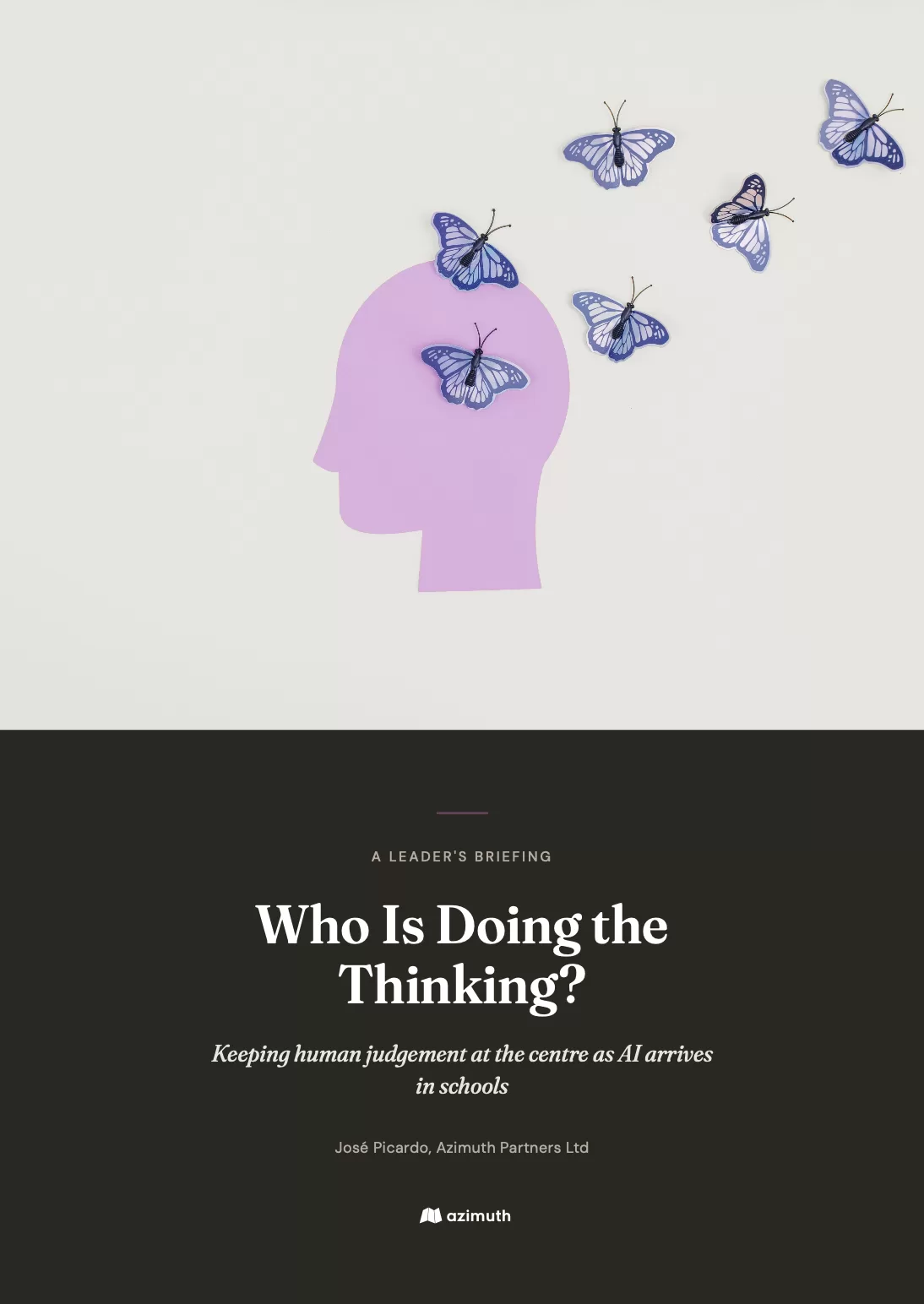
Who is doing the thinking?
It is the question I keep coming back to. So I have written a short briefing around it.
Who Is Doing the Thinking? sets out a bearing to guide school leaders’ thinking on AI, whatever the technology does next, with two practical tools: a six-question self-check to take to your senior team, and six moves for next term.