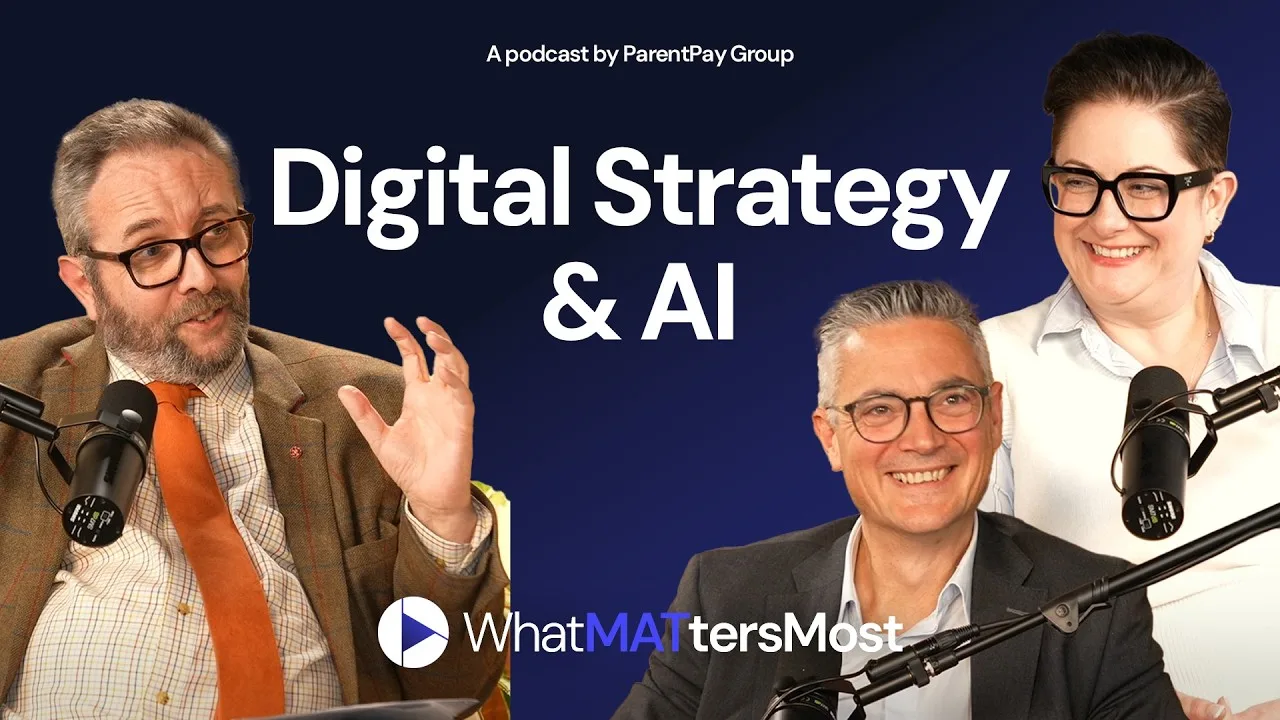
I joined Al Kingsley and Laura Knight on What MATters Most to talk about digital strategy and AI in schools. Over eighty minutes we kept coming back to the same idea. Start with what your school values, and the tools follow.
You can also listen on Spotify or Apple Podcasts.
It was a real pleasure to take part. Al is a generous and thoughtful host who chairs a multi-academy trust as well as making the series, and Laura, of Sapio, is one of the clearest voices on AI in education I know. They were wonderful company, and the conversation felt like the best kind of staffroom chat, with lots of good fun and even some friendly disagreement. Thank you both, and thank you to the team at ParentPay Group for making it happen.
Here are the threads I took away.
AI changes a lot, though not everything
Al opened by asking what is different this time, given how many promised revolutions in edtech never arrived. My answer was that AI changes a lot of things without changing everything, and starting from there keeps the conversation practical. It also means listening to the sceptics. Pessimists are the people who put lifeboats on ships, and in schools their caution usually comes from deep knowledge of the craft.
Laura added that AI is an umbrella term for several quite different things, from chatbots to features built into tools we already use to the newer agentic products. Much of it has arrived through consumer use rather than by decision, so policy often feels as if it is catching up.
Strategy starts with values
I have long said that a digital strategy is a teaching and learning strategy with the technology made explicit. AI is no different. Every conversation I have with senior leaders about it comes back to what the school stands for and how it wants its teachers to teach.
Thinking about AI only in terms of efficiency leads to decisions people regret, such as cutting teaching assistants or loading more onto teachers because they can now do more. Recent reporting suggests AI is raising productivity without reducing workload, because more gets expected. Laura asked whether freed-up time could simply be left free, so that teachers get some of their Sunday afternoons back.
Laura also named a common mistake, which is going shopping first and writing the strategy afterwards to justify the purchase. She warned that rules which are draconian or shaming push staff towards shadow IT, while good work in this area is open, collaborative and ongoing.
Short policies that people can read
Al imagined an AI policy wheeled in on a trolley, 475 pages long. We all agreed that a good policy is short, written in plain language and understood by everyone from the person on playground duty to the kitchen team. It should signpost what the school values, link to safeguarding and the staff code of conduct, and tell parents what is going on so they do not fill the gaps with assumptions.
Laura made a strong case for putting procurement and pilots inside the policy, with a clear process for trying something new, a fixed end date and an honest look at the evidence before deciding whether to keep it. I asked how long we will need AI policies at all. I am old enough to remember internet policies, and they quietly disappeared into everything else.
Where it is helping
Laura described strong work in SEND and adaptive teaching, where AI makes levelled texts and accessible versions of existing resources quick to produce, especially alongside assistive tools such as text to speech. For me, the clearest gains are when AI lifts administrative work so teachers can put their time into their subject and their teaching. The other is for children who find school difficult and are learning in specialist settings or at home, where these tools are already making a difference.
Where it is going wrong
Many pupils, and plenty of adults, use AI as a shortcut. I argued that cognitive offloading is fine. We do it with calculators and satnavs. The problem is cognitive outsourcing, where the whole process is handed to the machine. Laura preferred the distinction between transactional and transformational use, and pointed out that easy shortcuts expose tasks that were busy work all along. If pupils are not thinking critically with AI, then teaching them to think critically with it is the answer.
Laura also raised a newer worry. Social media competed for our attention, while some AI companions now compete for attachment and intimacy. That makes work on healthy habits in the early years and Key Stage 1 important, long before Year 9.
Questions for governors
The question I would have governors ask senior leaders is simple. What do you hope AI will do, and what do you fear will happen if it is used badly? The answers surface a school's assumptions quickly. I also said that AI strategy belongs to leadership. When I start work with a school I want to speak to the pastoral lead, the safeguarding lead and the academic deputy before the IT manager. Al added a question of his own, which is how you plan to measure it. Laura shared the red flags she teaches governors to look for and urged them to revisit consents, such as photos on school websites, now that deepfakes exist.
Training without AI fatigue
A single INSET day on AI does little, and frequent AI sessions soon bring on fatigue. The approach I prefer folds AI into training on things we already know work. A session on retrieval practice or dual coding can show how AI helps with that, so AI becomes part of good teaching instead of an extra topic.
Looking ahead
In five years I think we will stop talking about AI, because it will be built into everything we use. Laura expects the conversation to move on to ownership, data and sovereignty. Asked what a pupil leaving school in 2035 will need, Laura said discernment and judgement, and I added knowing when not to use AI. Al ended on a hopeful note. The more this technology weaves into our lives, the more we will value the things that make us human.
Our message to the edtech industry was the same from all three of us. Respect the profession, build products with teachers, and solve the problems schools actually have.
Do find Al at alkingsley.com and Laura at sapio.company. Both share a great deal of useful work, and the rest of the What MATters Most series is well worth a listen.

Comments