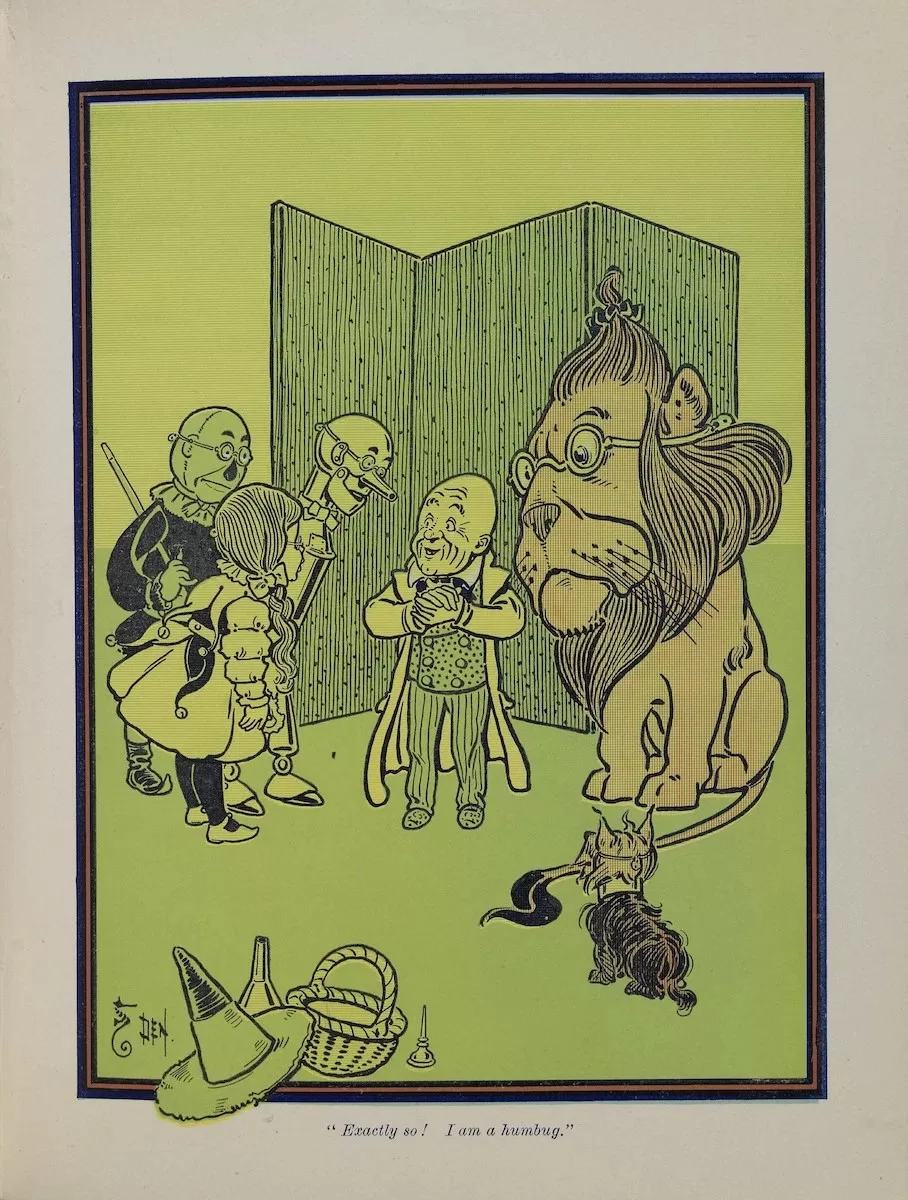
Near the end of L. Frank Baum’s novel, Toto knocks over a screen in the corner of the throne room and the Wizard of Oz turns out to be a small, bald man with a wrinkled face. The Scarecrow is so unimpressed he tells him he is a humbug. The wizard does not deny it. He agrees at once, and cheerfully: “I am a humbug.”
Then he hands out bran, pins and needles for the Scarecrow’s brain. A silk heart stuffed with sawdust for the Tin Woodman. A drink from a green bottle for the Lion’s courage.
The bran is just bran and the sawdust is just sawdust. The gifts only appear to work because each of the three already had the quality he was asking for. The wizard supplies the occasion and nothing more.
I can think of no better analogy for a large language model in a classroom, and none that breaks in a more useful place. I will come back to that.
A model predicts the statistically likely next word (or token, to be precise). It does not know what mathematics is, and it does not understand the essay on Macbeth it has just produced. As with the Wizard of Oz, front of house is magnificent. Behind the screen, however, is just an algorithm pulling levers.
Every pupil and teacher in the country gets the same fluent, confident, plausible paragraph. What varies is what happens next. A pupil with knowledge can argue with it, test it, throw out the third sentence and rebuild the fourth. A pupil without it can only accept what arrives, and has no way of telling whether the paragraph is even true. The same applies to teachers planning lessons or crafting resources. There are considerations here about access and equity. Who gets taught to do the arguing is a question I’ll come back to.
Two essays, one shadow
Picture a school hall on the first day of September. A hundred colleagues, pastries in hand, braced for the usual fare: a new tool to get your head around, slides on statutory requirements, a policy to sign.
What they get instead is a single sentence. If a pupil is not doing the thinking, that pupil is not learning, however polished the work she submits.
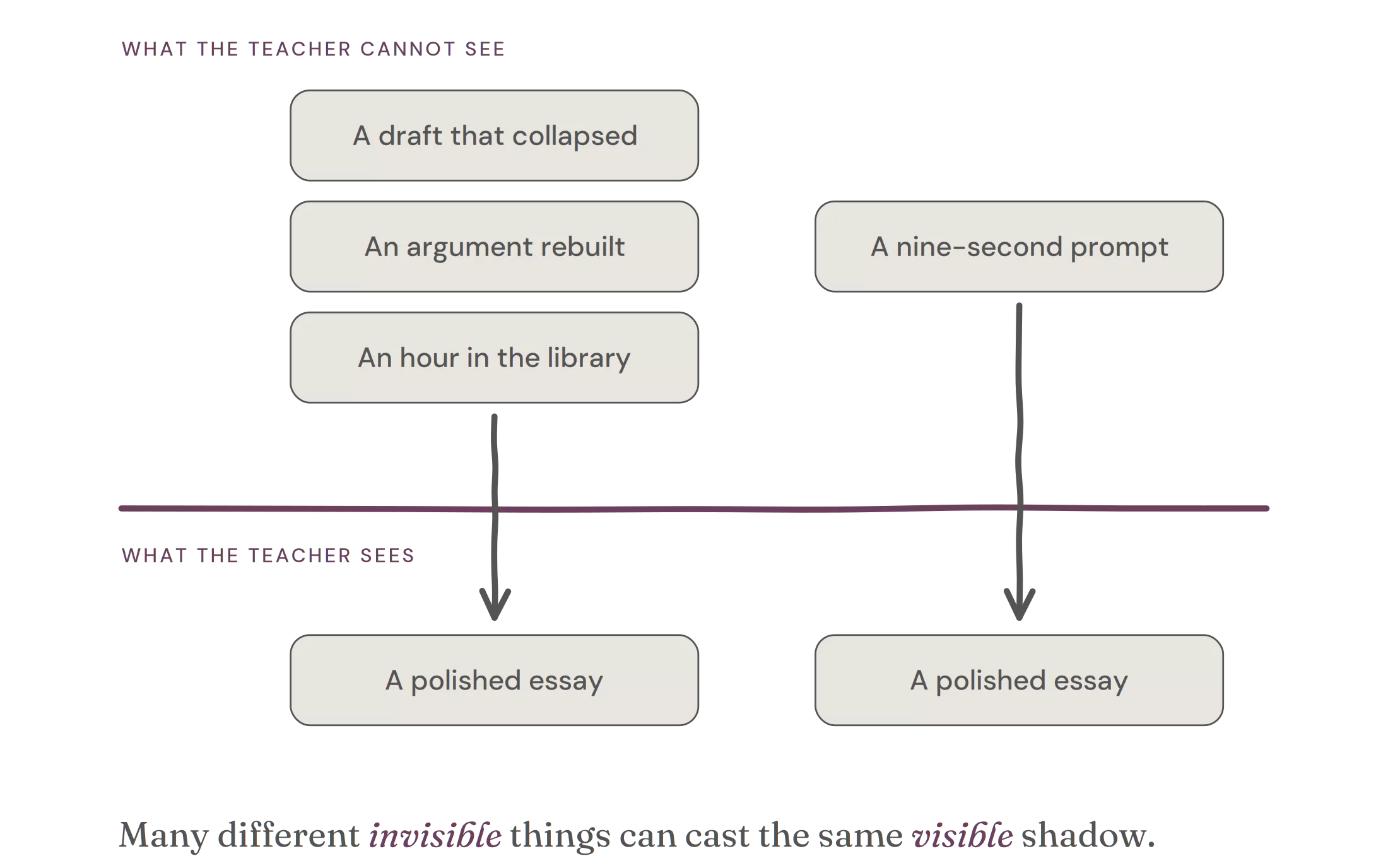
Becky Allen makes a point that explains why that sentence is so hard to act on: many different invisible things can cast the same visible shadow. Take two essays on a teacher’s desk. One took a whole evening of structured effort: a draft that collapsed, an argument that had to be rebuilt, an hour in the school library, and all the friction that proper learning requires. The other took nine seconds with a chatbot. To the teacher marking them, the shadows are nigh on identical.

Can you spot him? Liu Bolin is a Chinese artist who blends into the background.
Generative AI became ambient almost by stealth. It arrived in predictive text, in the photo app that recognises faces, in the language app that remembers your weaknesses and adapts, and in the word processor offering a better version of your sentence. By the time schools began drafting acceptable use policies, pupils had folded it into their week. The National Literacy Trust’s most recent survey finds around four in five 13 to 18 year olds using AI, teachers reporting similar levels, and a quarter of pupils admitting they simply copy what it gives them for homework.
That makes the argument about permission a late one. It also makes both familiar positions the same institutional move in different clothes. A ban hands the school’s professional judgement to caution. A blessing hands it to whoever built the tool. Either way the school has stopped thinking, and a school that has stopped thinking cannot teach pupils to do it.
What the evidence shows, and what it does not...
Some of the strongest evidence we have comes from Bastani and colleagues, working with nearly a thousand secondary pupils in Turkey. Pupils tackled mathematics across four sessions. One group used a textbook and their notes. A second had unrestricted access to GPT-4. A third used the same model, constrained by a system prompt so that it behaved like a tutor: it declined to supply answers and asked what step the pupil thought should come next.
During practice, the unrestricted group improved by 48% over the control. Walking that room, you would have concluded the technology was working beautifully. Then the laptops closed and everyone sat the same problems unaided. The unrestricted group scored 17% below the control. The pupils who had struggled with a textbook outperformed the pupils who had been helped.
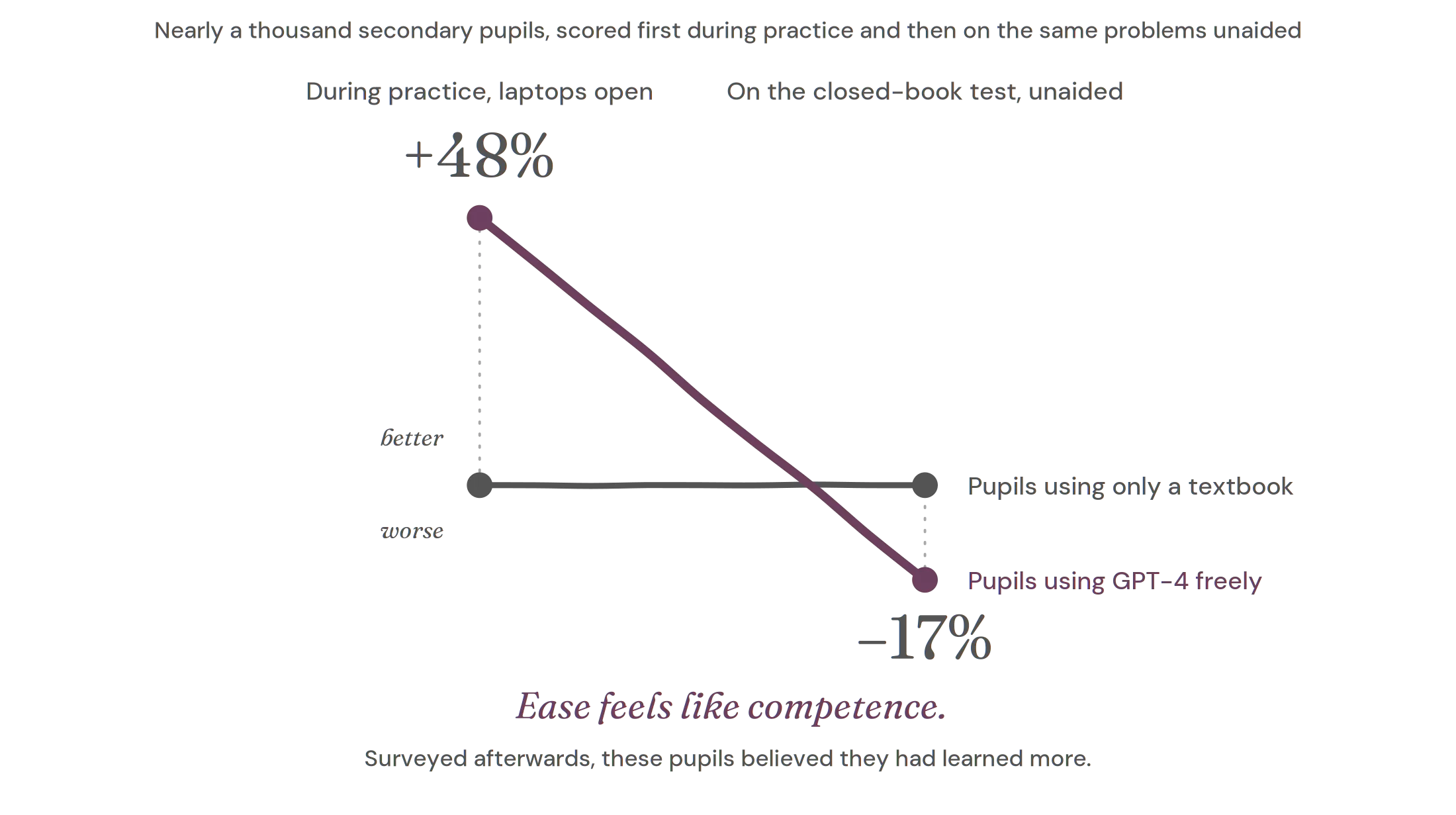
The guardrailed group did best of all in practice, improving by 127%, and on the closed-book test they finished level with the control. Though it is important to note that in this study the design removed the harm, but it did not produce a gain.
Two details deserve attention. Around 80% of the unrestricted group’s exchanges contained a direct request for the answer. And when surveyed afterwards, those pupils believed they had learned more, even as they had learned less. Ease feels like competence. It is one of the more dependable illusions in cognition, and adults (teachers planning lessons with AI, say) are no less prone to it.
If the harm sits in the design, so does the remedy. A pupil facing a blank page types plan my response, and the structuring, sequencing and prioritising all happen inside the model. A pupil who writes a messy draft first and then types what am I missing here? has already done the generative work, and the model returns a critique the pupil must weigh. Same tool, same minutes at the screen, opposite cognitive outcome.
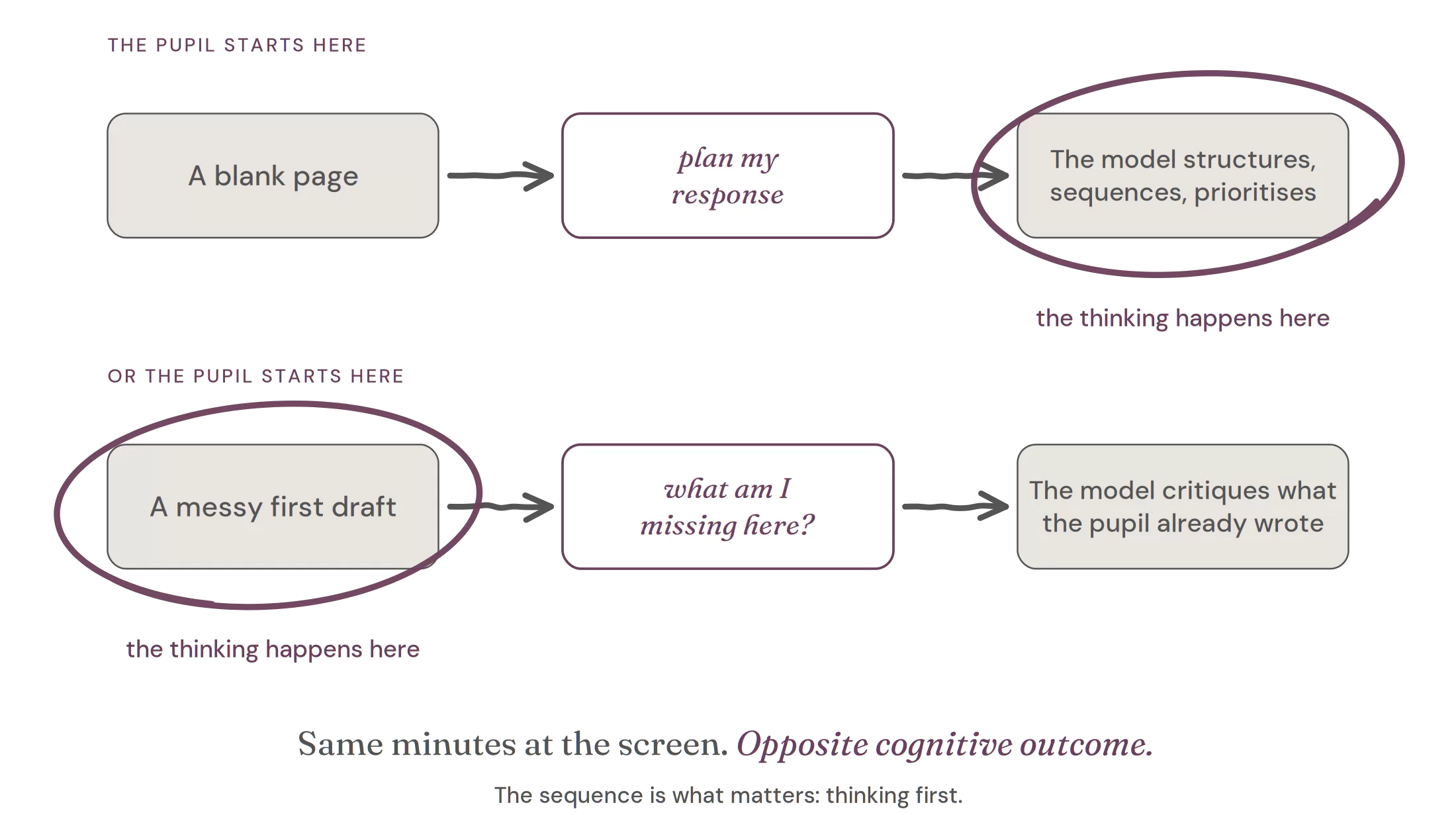
Nothing in the curriculum needs to move. What moves is where in the sequence the thinking is required, and how much of it happens where a teacher can see it.
For the essay that arrives suspiciously clean, detection software is a blunt instrument and an expensive way to damage a relationship. A question does better. Could you explain or defend this without the AI? It carries no accusation, and it puts the value of the work back where it belongs.
The adults in the room
Let’s now throw some teacher use of AI into the mix. TALIS 2024 surveyed teachers across 55 systems, England not among them, and found just over a third had used AI in their work. Of those who had not, three quarters said they lacked the knowledge and skills. I suspect that may be a professional development problem, not a technology one.
Training matters more than it appears to, I think, because machine competence is uneven in ways human competence is not. Dell’Acqua and colleagues, studying management consultants, described a jagged frontier: tasks the model handles superbly sit alongside tasks it fails, with no visible boundary between them. Consultants working inside the frontier improved sharply. Those who strayed outside it without noticing were markedly more likely to be wrong than colleagues using no AI at all. The tool accelerates. It does not steer. If you start wrong, you’re likely to stay wrong.
Inside the frontier then, the gains are real. An EEF trial with 259 science teachers cut lesson planning time by roughly a third with no drop in quality as judged by independent evaluators. For an overstretched workforce, a third of planning time is a serious offer.
It is also unevenly distributed, which is that equity question again. Sutton Trust research found teachers in independent schools more than twice as likely to have had formal AI training as colleagues in state schools, 45% against 21%, and around three times as likely to report a whole-school strategy. The divide has moved. It now runs between those who have been taught to think effectively with AI and those left to work it out alone, and the same fault line runs through the pupils in their classrooms.
The measurement problem
Underneath all of this sits something AI did not create and has now made impossible to ignore. For a century, good written work was a dependable proxy for good thinking, because producing the one required the other. Scarfe and colleagues slipped AI-generated submissions into the marking pile at a UK university. Markers missed 94% of them, and the AI work outscored real students in the large majority of direct comparisons.
Leaders reach for proxies too, which is why, when it comes to AI, leadership needs to return to first principles, in a fixed order. Values, then pedagogy, then technology. Begin with the technology and you will find yourself designing tasks to justify the product.
There is a reason to care about this beyond the exam hall. Brynjolfsson, Chandar and Chen, working with US payroll records, found a relative decline of roughly 19% in employment among workers aged 22 to 25 in the occupations most exposed to AI. Consider what an entry-level job has traditionally consisted of: summarising meetings, drafting standard documents, writing routine code. Those tasks sit comfortably inside the jagged frontier and are absorbed first.
Firms tolerated a graduate’s clumsy first drafts because the drafting was the apprenticeship. The output was rarely the point; the learning was. Schooling runs the same bargain, earlier. Firms may find they can skip the apprenticeship. Schools cannot, because in a school the apprenticeship is the product.
Where the analogy breaks
So back to the wizard’s hall, and to the place where the story stops helping. The Scarecrow arrived with a brain. He needed the bran only to believe in it. A pupil arrives at school in order to grow one, and that changes what the bran can do. In Oz the gift was harmless, because the work was already done. In a classroom the gift can stand in for the work, and the pupil leaves, like Bastani’s, convinced she has learned more than she has.
The wizard’s gifts worked because the qualities were already inside the three of them. An essay works when the thinking takes place inside the pupil. The machine only supplies the occasion. That is what the sentence on the first day of September was pointing at. Where, in this lesson, is the thinking happening, and who is doing it? The answer decides whether a pupil does the work that makes the gift function, or lets the gift do the work and mistakes the one for the other.
Who is doing the thinking?
It is the question I keep coming back to. So I have written a short briefing around it.
Who Is Doing the Thinking? sets out a bearing to guide school leaders’ thinking on AI, whatever the technology does next, with two practical tools: a six-question self-check to take to your senior team, and six moves for next term.