


Some years ago, before I started Azimuth, I was asked to help a school in our group with their digital strategy. I arrived, and almost immediately someone was leading me down to a basement towards the office of the Director of IT. I stopped and asked politely to see the deputy head academic and the assistant head for teaching and learning instead. Back up the stairs we went.
The Director of IT does important work. That is not the point. The reason why I declined to see him first (it was a him) was because a good digital strategy is really a teaching and learning strategy, one in which the use of technology has been made deliberate. Most schools’ instinct, to file digital under hardware and IT support, was the very thing I had come to talk about.
Teaching and learning rightly sits at the top of every development plan and gets its own slot in every important meeting. Digital training is often the optional extra. It is the twilight session cancelled when the timetable is under pressure, the budget line that gets deleted first, the thing we will get to once the other, more important work is done.
Older than the technology
I think we have been making this mistake for a long time. It is tempting to blame the latest technology, enter artificial intelligence, for the pressure we suddenly feel, but that pressure is older than the technology. AI has only made it impossible to ignore.
In fact, the truth is older than most edtech. It goes back to the moment the web stopped being a place you visited and became something that came to you. Once information could reach a pupil on demand, the job of learning began to change. Knowledge mattered as much as it ever had, perhaps more, because a well-stocked mind is the only thing that can judge whether the answer arriving on a screen is any good.
”A well-stocked mind is the only thing that can judge whether the answer arriving on a screen is any good.
What changed is the world that knowledge now had to be built in: information was cheap, instant, and potentially wrong. We noticed, and largely carried on as before, because other things felt more urgent. What we missed is that digital capability (I hesitate to call it literacy) and teaching and learning had become the same problem. Neglect one and the other suffers. It is a circle, and at the moment, it’s turning the wrong way.
The honest objection
Before going further, I want to give the obvious objection its due.
The evidence that technology improves learning is, frankly, underwhelming. Those of us who work in this space have come to terms with this fact. Anyone who has read the research knows the average effect of digital tools on attainment is modest, and that plenty of technology in schools does visible harm. Phones that fragment attention. Apps that manufacture the appearance of engagement while very little is learnt. Faced with all this, a sensible head might reasonably treat the decision to deprioritise digital as good judgement rather than neglect.
And you can see why this might make sense: everything in schools is already a priority. Staff are stretched. Adding digital training to a list that runs from safeguarding to assessment to wellbeing feels like one demand too many, and digital becomes a reasonable candidate to drop.
The wrong question
Here is where I think the objection goes wrong.
We have been asking whether technology improves learning. It is the wrong question, and it always has been, because technology on its own improves nothing. The Education Endowment Foundation puts it about as plainly as a research body can: buying a tablet for every child will not raise attainment, and what makes the difference is the pedagogy and the context in which it is used. That underwhelming average has been badly misread. We have been reading it as a verdict on technology, when it was only ever a verdict on us.
”We have been reading it as a verdict on technology, when it was only ever a verdict on us.
The better question is this. How can the things teaching and learning already depend on, retrieval practice, modelling, feedback, the slow work of self-regulation, be done better with tools built for the purpose and placed in expert hands?
Ask it that way and the evidence stops looking thin. The same review finds that technology can increase the quality and quantity of pupils’ practice and improve the feedback they receive. The Sutton Trust, when looking at schools’ current adoption of AI, found that the schools pulling ahead are the ones that train their staff, set clear expectations, and give someone the job of overseeing it. Same tools, different results, and the difference is whether anyone was taught to use them properly. Where the training is missing, the gap widens, and it widens fastest for the children who can least afford it.
Which is the paradox, seen from the other side. The training you drop in order to protect teaching and learning is one of the few things that might have improved it.
What it looks like in practice
None of this is abstract.
For years I taught tethered to the front of the room, because that was where the board, the tangle of cables and the computer lived. The day I could throw my tablet onto the screen wirelessly, I got my classroom back. I could move around, look over shoulders, and pull up the right diagram at the exact moment a class needed it. Responsive teaching stopped being an aspiration and became much closer to the description of an ordinary lesson.
Then there was feedback. I began recording voice notes instead of writing in the margin. A spoken note took thirty seconds where the written version might have taken two minutes, and across a full set of books that is most of an evening handed back to me. The feedback reached pupils faster, and it carried with it what the red pen never could: warmth, encouragement, and the occasional note of humorous incredulity at a silly mistake.
And then there is a pupil I think about often, though she is more a type than a person. She takes it for granted that she need not wait until morning to get a question answered, or for the library to open before she can access a crucial text or source. For her, self-regulation looks like retrieval practice she can summon on demand, software that works out where she is weakest and adapts as she goes. The information comes to her, which is the very shift I described earlier, now reaching all the way into how she learns.
The same tools, untrained
Having said that, the same tools, in untrained hands, can do the reverse. The quizzing app becomes busywork. Nobody opens the feedback dashboard. The most revealing case I have met lately was a school head who was very keen to not encourage her teachers to use AI to help write subject reports.
Her worry was reasonable on the surface. She was sure that, given the option, most staff would take the lazy route and ask the AI for polished but ultimately bland, generic reports with nothing of the child in them. What she had not considered is that a model trained on effective feedback strategies, given the teacher’s own voice and the school’s data, can help a capable teacher produce a better report than the one they would otherwise write of an evening, ninety times over, somewhere between their own children’s bedtime and their own.
There are two things wrong with her position. She is holding a door shut on better, more humane reporting for the very staff who need it most. And she is treating a human failing as though technology had invented it. A teacher who would let a machine hallucinate ninety reports was already a teacher whose reports could not be trusted. That is a competency problem, not a technology one, and competency problems are as old as the profession.
”A teacher who would let a machine hallucinate ninety reports was already a teacher whose reports could not be trusted.
Where the training belongs
So what does this ask of us?
It asks that we stop treating digital training as a separate thing bolted to the side of the real work. If using our resources well genuinely improves teaching and learning, then training people to use them well is part of teaching and learning. That single shift, in how we classify the work, changes where it sits. It belongs in the development plan beside everything else that matters, and it belongs to the people who lead teaching and learning. When savings have to be found, it should be among the last things to go.
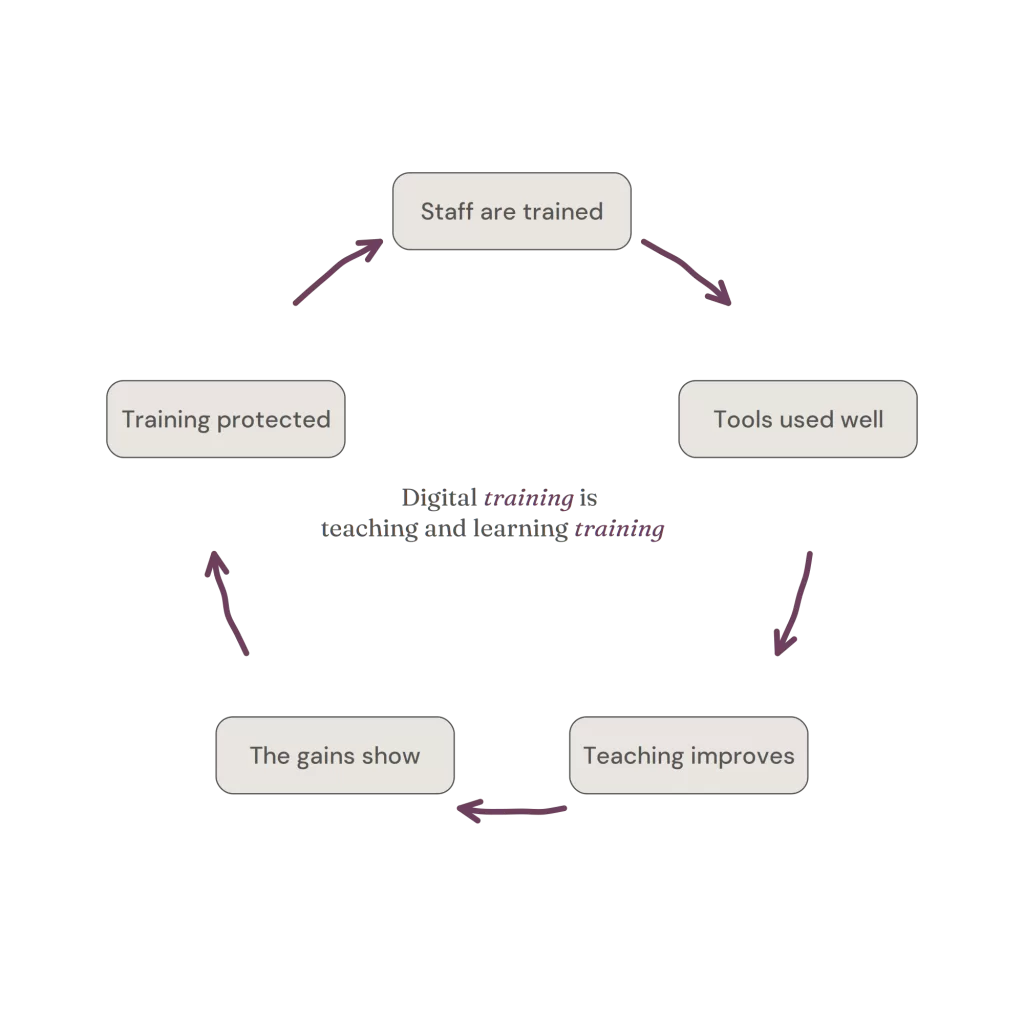 Do that, and the circle starts to turn the other way. Train people properly and they use the tools well. Use the tools well and the benefit shows: calmer classrooms, faster feedback, pupils who can keep themselves moving. No single tool changes a school on its own, and none of mine did. But marginal gains compound. A modest improvement to retrieval, another to feedback, another to how pupils manage their own practice, and over a year, across a whole cohort, the gains stop being modest. Once that benefit is visible, the training has earned its place, and the next round of it is far easier to protect. The vicious circle becomes a virtuous one, turned by nothing more exotic or complicated than understanding that training teachers to teach well using the resources they have is not a nice to have, but the main task.
I think back, sometimes, to that corridor and the walk towards the Director of IT’s office. I have come to believe you can read a school’s understanding of all this by who it takes you to see first. A school that has grasped the paradox would skip the server room and walk a visitor straight to the deputy head academic, because by then everyone in the building understands that the digital strategy and the teaching and learning strategy are the same conversation, and always were.