

What if we could teach more effectively by understanding how learning truly works? That was the guiding question behind a recent McGraw Hill webinar led by Dr Carl Hendrick, a teacher, researcher, and co-author of How Learning Happens. His talk, The Science of Learning meets Direct Instruction, offered a rich, practical distillation of decades of research into how pupils learn, and, just as crucially, how they forget.
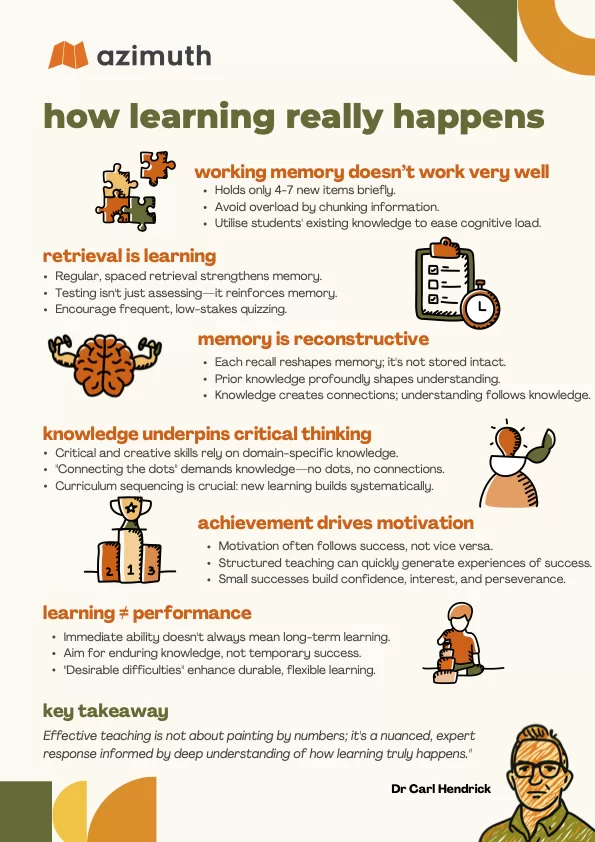
Hendrick walked us through six foundational insights from cognitive science that all teachers should know:
- Working memory doesn’t work very well: Our cognitive “workspace” is startlingly limited—just 4–7 items at once. Effective teaching must avoid overloading it.
- Retrieval is learning: Regularly recalling information strengthens memory far more than simply re-reading or highlighting.
- Memory is reconstructive: We don’t replay memories, we rebuild them each time. Long-term memory is the true engine of understanding.
- Knowledge enables thinking: Creativity and critical thinking rest on a bedrock of domain-specific knowledge. You can’t connect dots you don’t have.
- Success drives motivation: Rather than waiting for motivation to ignite achievement, structured teaching builds early success, which in turn fosters motivation.
- Learning isn’t performance: Just because a student gets it today doesn’t mean they’ll remember it tomorrow. Durable learning requires spacing, retrieval, and desirable difficulty.
In championing structured, explicit teaching, Hendrick made a compelling case, not just for better test results, but for greater equity. When well-sequenced, knowledge-rich instruction is paired with responsive checking for understanding, students of all backgrounds are more likely to experience success.
This was more than a talk about methods; it was a rallying call to bring evidence-informed practice to the chalkface. As Hendrick reminded us, great teaching isn’t mechanical. It’s responsive, passionate, and deeply human, but it should also be illuminated by what we now know about how learning happens.
”We have a science of learning. Do we have a science of teaching?
— Dr Carl Hendrick