

Every school I visit has a version of the same meeting. Heads of department around a table, facing a deadline to contribute to a policy for something they fear. And that fear has an unusual range, from “what do we do about homework?” to “will this end the human race?” … often with very little in between.
Since everyone feels impotent about the second question, we usually focus on the first. If a chatbot can produce a passable essay in eleven seconds, what is a piece of written homework now measuring? Some argue that homework as a means to measure attainment is dead. With some reason. Some departments have already moved assessment into the classroom. Others are buying detection software. A few are redesigning homework from first principles, which is the right instinct, though exhausting and seemingly immediately nullifying AI’s promise to cut workload.
What strikes me is the shape of these conversations. In two years of them, after a keynote or an INSET session, almost nobody has asked me what AI could be good for. The questions are usually about risk: cheating, dependence, thinking, the environment, the end of humanity. Reasonable questions, every one. But always risk.
And to top it all, in the papers and in the news bulletins, the normalisation of the claim that this is the technology that ends us. Nobody in a homework meeting says that out loud. But it undoubtedly frames how the technology is perceived.
That shape has a history. A sociologist drew the map half a century ago.
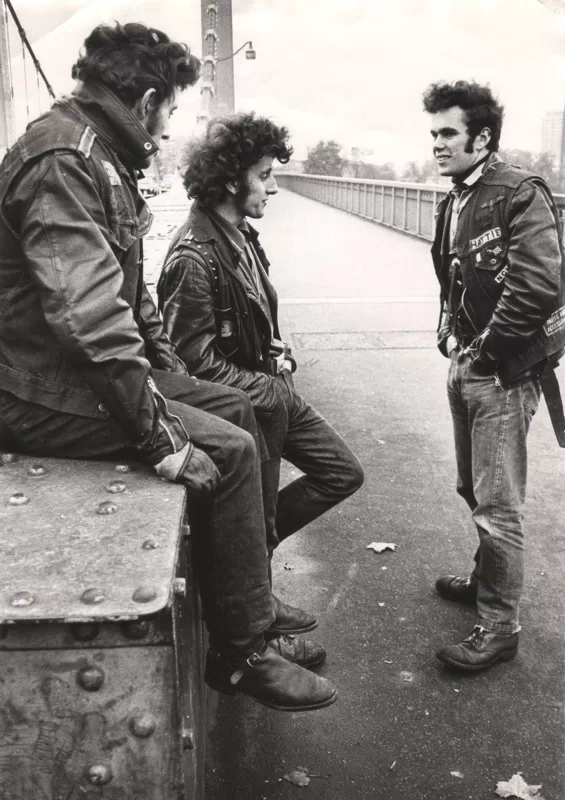
Chelsea Bridge Rockers, By Triton Rocker
Mods, Rockers and a wet bank holiday
Over Easter 1964, groups of Mods and Rockers scuffled on the seafront at Clacton, now in the news as a different kind of battleground. The fights were minor, but by the time the newspapers had published their account, Britain’s youth were at war with civilisation. Stanley Cohen was interested in the reaction rather than the fights, and his book, Folk Devils and Moral Panics (1972), gave us the term we still use.
A moral panic, in Cohen’s sense, happens when a group, a behaviour or a thing comes to be defined as a threat to a society’s values. A few ingredients recur. There is a folk devil, the figure onto whom the fear is projected. There are moral entrepreneurs, the campaigners, commentators and experts who make the case for alarm. There is media amplification, where each report compounds onto the next one. And there is a response, usually from people with the power to make rules under pressure to make some.
Cohen borrowed his sequence from studies of how communities react to disasters. Textbooks have since tidied it into five stages, and I’ll use that version later. It’s a simplification, of course, but I think a useful one.
A panic without a face
Here is where AI is different. Cohen’s folk devils were people. You could photograph them: a Mod on a scooter, a teenager’s face hidden behind a comic, or a young woman reading a novel.
AI has no face. The thing being feared is a data centre and a chatbot text box. So the panic does what panics do and finds proxies. The cheating student. The teacher who marks with ChatGPT. The colleague who “only uses it to draft emails”, as letting on they use it more extensively still feels like an admission of incompetence. Those heads of department are not frightened of a server farm. They are frightened of what their own pupils, and their own colleagues, might be doing as a result of having intelligent access to one.
I think this is why the AI panic feels so personal in schools. When the folk devil has no face, everyone becomes a suspect.
And when a panic cannot find a face, it looks for a body. The nearest thing AI has to one is the data centre, which is why the second question I get asked in schools, after cheating, is about water.
The concern has a basis. A peer-reviewed estimate puts a small 1 MW facility with conventional cooling at around 25 million litres a year, and where facilities cluster in water-stressed regions, that matters. But hold the number against the things nobody feels guilty about. Levi’s own figures put a single pair of jeans at up to 3,800 litres over its life, so that data centre runs for a year on roughly seven thousand pairs, and Levi’s alone sells tens of millions. Textiles, agriculture and energy generation each dwarf the entire sector.
Cohen had a word for this: disproportionality, concern out of scale with the harm. The harm exists. What makes it a panic is where the guilt is placed. A teacher agonising over the water cost of a chatbot query, while preparing a ready meal, backing her iPhone photos to the cloud, looking to book a holiday to warmer climes, and yes, while wearing a pair of jeans, is inside the panic without realising.
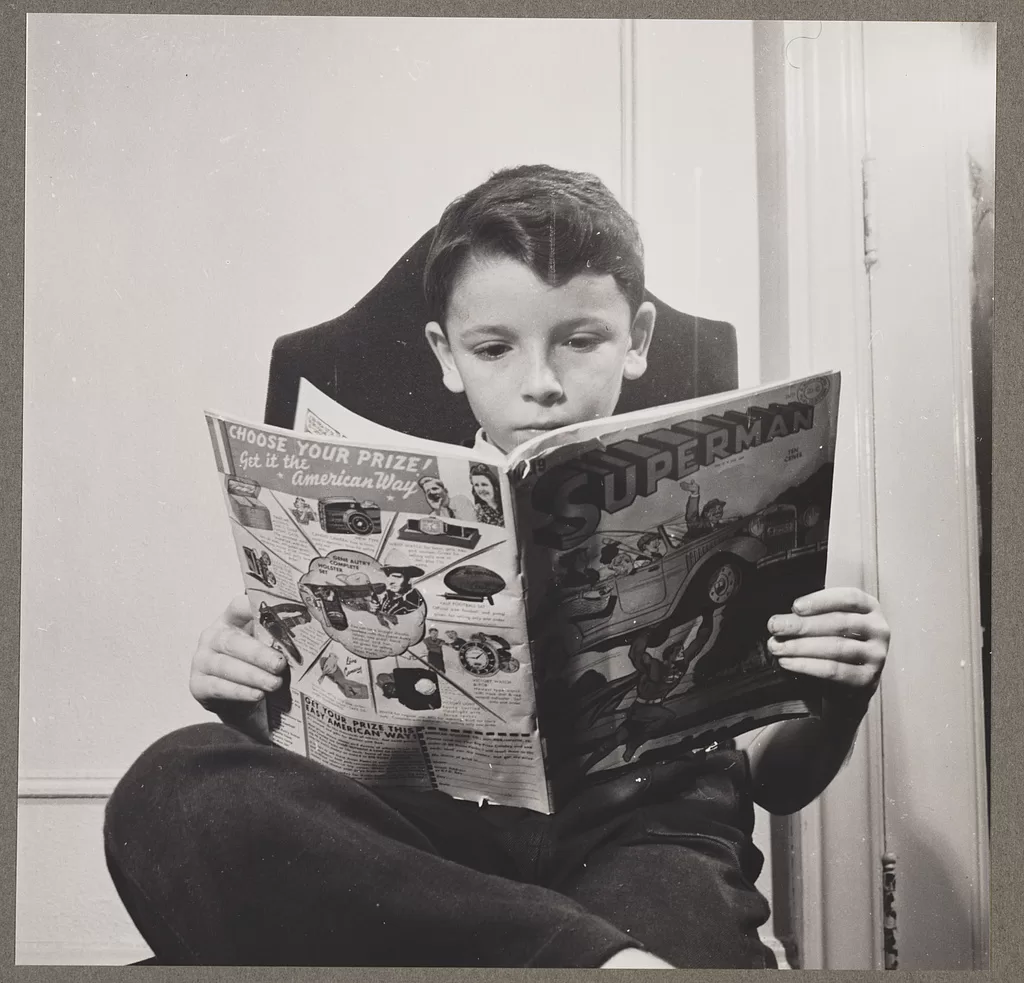
German refugee child, a devotee of Superman, 1942
We have been here before
The dangerous novel
Through the eighteenth and nineteenth centuries, critics argued that readers absorbed the emotions of what they read like an infection. The worry landed hardest on young women, who were thought especially vulnerable to having their heads turned by fiction. (Aeon has a fine history of this.)
Today we run reading-for-pleasure initiatives and fret that children don’t read enough novels.
Comic books go to Washington
The comic book panic is the purest example of Cohen’s model I have found. In 1954, the psychiatrist Fredric Wertham published Seduction of the Innocent, arguing that crime and horror comics were driving juvenile delinquency. That April, the US Senate Subcommittee on Juvenile Delinquency held televised hearings with Wertham as star witness. The National Archives holds the testimony if you want to read it in the original.
Every ingredient is present. A folk devil (the comic, and the delinquent reading it). A moral entrepreneur with credentials. Amplification by the new medium of television. And a response: fearing regulation, the industry adopted the Comics Code Authority, a self-censorship scheme some publishers were still using in 2011. Wertham’s research was later shown to be badly flawed.
Mortal Kombat on Capitol Hill
Forty years later, video games had their turn. The 1993 hearings, led by Senators Joe Lieberman and Herb Kohl, pressed the industry over realistic violence and threatened regulation unless it acted, which led to the creation of the Entertainment Software Rating Board. The original footage is on C-SPAN.
My favourite detail concerns Night Trap, held up as evidence of violence against women. Toys “R” Us pulled it from the shelves. Yet the player’s goal in the game was to save the women from vampires, and nobody even killed the vampires. A panic had run a long way ahead of anyone actually playing the thing.
What the pattern leaves behind
Look at those last two examples again. Both panics faded, yet both left a legavy: the Comics Code, the age rating on every game box… Panics end, but the rules written at their peak tend to outlive them. Hold on to that thought.
To be fair to the critics
It would be a bit rich to write an essay about exaggeration and then oversell my own case. So here are the main criticisms of Cohen’s model.
Who decides what’s proportionate? The idea of a panic depends on the reaction being out of scale with the threat. But you can only call a reaction excessive if you already know the true size or shape of the harm. With AI, we just don’t know yet.
Sometimes the fear is justified. The model can imply that the folk devil is always innocent. Cohen himself accepted that some trivial things get blown out of proportion while some genuinely terrible things get ignored. The end-of-civilisation claim belongs here. I personally find it implausible, but I also cannot show it is wrong.
It can be used as a weapon. Call something a moral panic and you can dismiss any concern without engaging with it. Cohen wrestled with this late in his career, in a 2011 essay pointedly titled “Whose side were we on?”
When the alarm was justified
The strongest counterexamples are the alarms that turned out to be correct.
Leaded petrol is one. Doctors first warned about its toxic effects nearly a century before Algeria, the last country to use it, ran out of supplies in 2021. It affects brain development, especially in children, and the UN estimates that the ban prevents more than 1.2 million premature deaths a year.
Tobacco is another. The warnings were waved away for decades. According to the World Health Organization, it now kills more than eight million people a year.
In the comic and video game panics, the evidence never arrived. In the leaded petrol and tobacco cases, the evidence piled up and was resisted by the industries that profited.
And here the AI story does something no previous panic has done. The AI industry is not playing the harm down. The people building these systems are among the loudest voices warning that they might end civilisation. This time, the moral entrepreneur is also the one selling the product.
There are at least two takes. One is that they mean it and that they are genuinely worried. Another is that a warning is also a moat: if AI is dangerous enough to need regulating, the rules tend to favour the companies already large enough to comply, and raise the drawbridge against cheaper rivals. I don’t know which reading is right and I suspect both are partly true.
The end-of-humanity story is, strictly, a different panic from the one in the staffroom, aimed at regulators and investors rather than heads of department. But it spreads. A teacher who is convinced that AI might end the world is not going to feel relaxed about deploying it in her practice.
Where we are
Here is how I think the five stages map onto AI, with a sign or tell for each, so you can check my take against your own.
Emergence. AI gets defined as a threat. The tell is the shift from curiosity to alarm. In schools it took a matter of weeks: ChatGPT launched in November 2022 and by the January term the first bans were in place. What was unusual was where the alarm started. Most panics begin small and escalate. With this one, however, the people who built the technology have signed a statement putting it alongside pandemics and nuclear war.
Amplification. The threat gets simplified and exaggerated. The signs are recurring headlines, highlighting single anecdotes as trends. With AI the spiral had little distance to travel. The extinction claim was there from the start; amplification carried it from open letters to front pages to staffrooms. And once the headline is the end of civilisation, there is nowhere left to go, which is itself a sign that this stage has peaked and the next one has begun.
Moral entrepreneurs. Commentators, campaigners and experts compete to own the issue. The tell is reputations being built on alarm (or, to be fair, on relentless enthusiasm).
Response. Authorities act with bans, detection software and hastily drafted policies. The tell is rules arriving faster than the evidence.
Normalisation. The technology becomes ordinary. The tell is linguistic, which pleases the linguist in me: people stop saying the word. Nobody says “I’ll look that up on the World Wide Web” anymore. When “I used AI to draft it” becomes as unremarkable as “I wrote it”, we’ll know.
Those heads of department tell me where we are. Homework being redesigned, detection software being bought, policies being written to a deadline: that is the response stage. And if the pattern holds, what comes next is the part the comic books and the games consoles both went through. The panic fades. The rules written during it stay.
The takeaway
Which means the AI policy your school writes this year is the one that will still be in force when nobody remembers why it was urgent. Write it for that world.
Write it about principles and values rather than tools. Eventually ChatGPT will be replaced by something else, so will Claude, Copilot, etc; a policy that names a product dates quickly. A policy that enshrines and protects what the school believes about honesty, effort and who does the thinking will outlast every product on the market.
And keep the human in every sentence. AI is at its most useful when it extends what a teacher or a pupil is already doing: drafting, questioning, checking, explaining. Write that into the policy as a positive, so the document describes the relationship you want rather than the behaviour you fear.
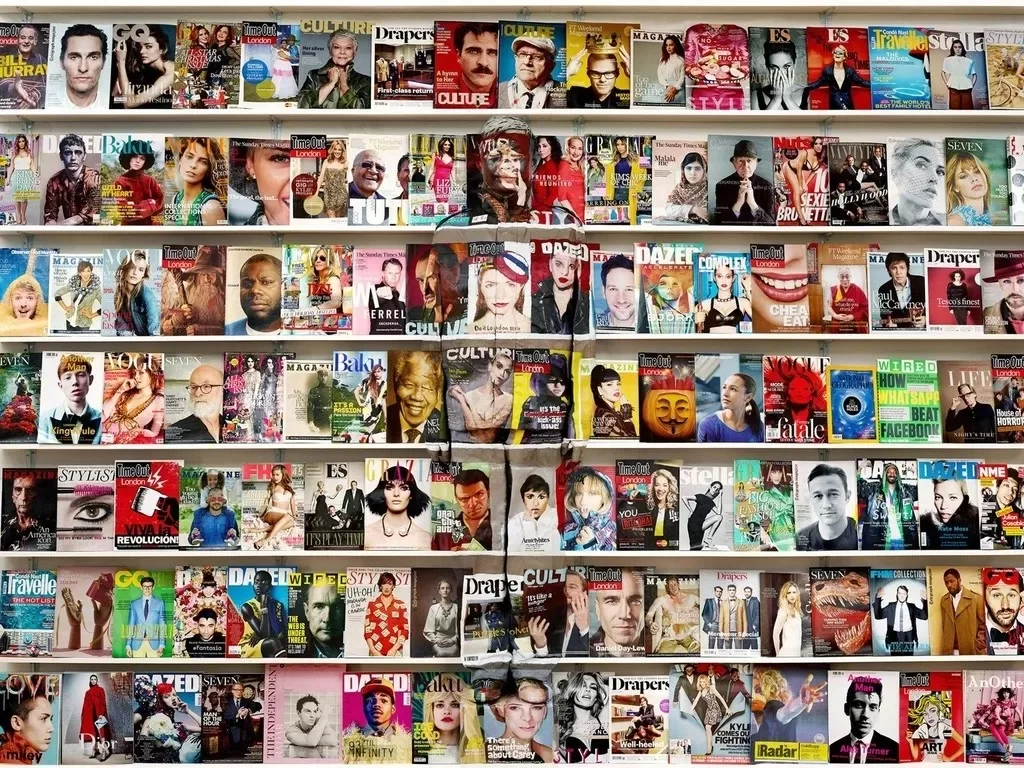
Liu Bolin, “The invisible man”
The invisible man
Which brings me to Liu Bolin.
Liu is a Chinese performance artist nicknamed “The Invisible Man”, and one I often refer to. His Hiding in the City series has left a deep imprint on my understanding of technology adoption. In it, his assistants paint him so precisely that he disappears into a bookshelf, a wall of cans, or a street. The series began as a protest after his studio in Suojia village was demolished in November 2005.
The final stage of a moral panic looks a lot like one of his photographs. The technology is still there, standing in the middle of the picture. We simply stop seeing it. The novel, the comic and the games console all went this way. In a few years, those same heads of department will sit around the same table and nobody will mention AI, because it will be in the marking, the lesson planning, the schemes of work, and the timetable.
But Liu has said something about his work that I keep coming back to. “Disappearing is not the main point of my work,” he explains. “It’s just the method I use to pass on a message.”
Which is the trouble with the last stage of a moral panic. We are so relieved when the thing stops being frightening that we take invisibility for an all-clear. But invisibility was never the finding. It was the method.
Who is doing the thinking?
It is the question I keep coming back to. So I have written a short briefing around it.
Who Is Doing the Thinking? sets out a bearing to guide school leaders’ thinking on AI, whatever the technology does next, with two practical tools: a six-question self-check to take to your senior team, and six moves for next term.