

I arrived early. The drive had been a long one, so I sat in the car until nearer eleven, the agreed arrival time. I have learnt to time my arrival at reception with just enough margin to sign in and collect the visitor’s lanyard. Inspections are stressful for everyone inside the building. An inspector wandering in thirty minutes ahead of schedule is not helpful to anyone.
On this occasion the head came out to welcome the team in person. Warm, composed, generous. And in the space of two minutes she used the word strength at least three times in reference to the school’s co-curricular provision. Not very subtle.
I understood the instinct completely. But I also knew that the inspection framework is explicit that significant strengths must be apparent to the inspection team without signposting from school leaders. A head who steers inspectors towards a perceived strength will be reminded, courteously, that the evaluation lies with the team.
So the accolade cannot be signposted explicitly on the day. How, then, does a school come to be awarded one? That question turns out to have an evidence base.
It also has a deadline. As this post is being written, ISI is hours from closing a consultation on removing the provision for reporting a significant strength from its framework altogether. Whatever the inspectorate decides, the corpus already tells us what the accolade rewarded while inspectors could award it, and that record is worth looking into in any case.
What the corpus shows
Most of what schools believe about inspection arrives second-hand. A colleague’s war story, a consultant’s checklist, the folk memory of the last inspection. The reports themselves go largely unread beyond the school named in each one.
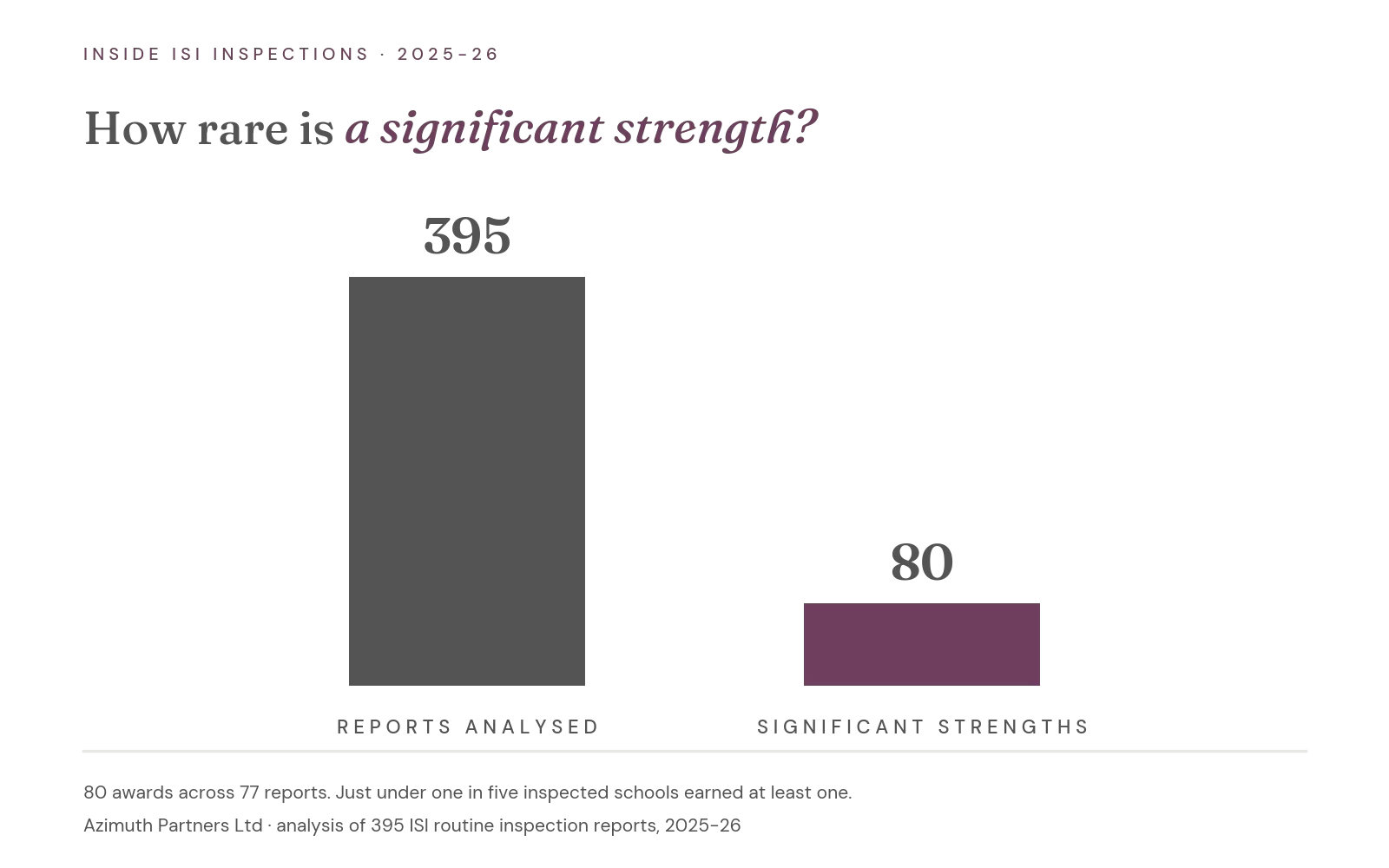
So I read them. All 395 routine inspection reports ISI published between May 2025 and April 2026. Every recommendation, action point and accolade tagged and counted. The phrase “significant strength” turns out to be ISI’s rarest form of praise. It appears 80 times across 77 reports. Just under one in five inspected schools. Three schools earned it twice in the same inspection. None managed a third.
Nobody likes a pushy salesman
A reasonable head might challenge me here. If the framework forbids schools from pointing at their own strengths, is preparing for the accolade a contradiction in terms? Or even worse, is it the kind of inspection-chasing that distorts a school’s real priorities?
Before we answer that I think the instinct to pitch deserves sympathy. A head greeting an inspection team is carrying the hopes of an entire community. Selling the school is what she does every working day, to prospective parents, to governors, to the local press. Of course the salesmanship surfaces under stress. The trouble is the timing, because by the morning the visitor lanyards are issued to inspectors, the judgement is already settled; it just hasn’t been articulated yet. Besides, inspectors can see a pitch coming a mile off. Nobody likes a pushy salesman.
Start the morning after
The schools that earn the accolade approached it from the other end. The strategic work starts early, ideally the morning after the previous inspection, at exactly the moment the school sits down with its recommended next steps or, in harder cases, its unmet standards. Alongside the list of what needs fixing belongs a different question: what are we really good at?
A caveat belongs here, because the data is blunt about priorities. Of the 49 schools in the corpus judged not to have met every standard, exactly one also earned a significant strength. Put the other way round, 76 of the 77 schools holding the accolade met every standard. For most schools, most of the time, the first call on strategic attention is the unglamorous essentials: the registers, the policies, the records where unmet standards actually accumulate. Chasing a significant strength when the basics are not met is clearly the wrong priority. The two kinds of work run on different clocks, though. Compliance is maintenance, termly and audit-shaped. A strength is cultivation, grown over years. A school can attend to both at once precisely because they ask for different kinds of attention.
”A school doing distinctive work that nobody can describe is, for inspection purposes, indistinguishable from a school doing ordinary work.
Then comes the discipline of choosing. One thing, perhaps two. The corpus is blunt about the odds: only three schools in 395 reports received more than one significant strength, so a school betting on a portfolio of five is fooling itself. Pick the practice with the deepest roots.
And then the real work, which is visibility. A pet project of a single member of SLT will likely not cut it. The strength has to be seen and felt by pupils, parents, staff and visitors simultaneously, built into how the school talks about itself and how it spends its time and effort. Articulation counts as much as practice here. A school doing distinctive work that nobody can describe is, for inspection purposes, indistinguishable from a school doing ordinary work. Do all of this early enough and honestly enough and the signposting takes care of itself: a few conversations into the visit, the inspectors have heard about the thing from everyone. There was no need to shout loudly.
What gets you a significant stregth
So, what counts as the thing? The framework sets three tests. A significant strength must show “a deep understanding of and aspiration for pupils’ development of knowledge, skills, and understanding”. It must be “attributable to the knowledge, skills and decision making of leaders, managers and/or staff”. And it must produce “very clear and highly beneficial impact for pupils involved, with consideration and mitigation of risk of detriment or denial of opportunity to other pupils”. Deliberate design, identifiable decisions, observable difference, and no cohort paying the price for another’s showcase.
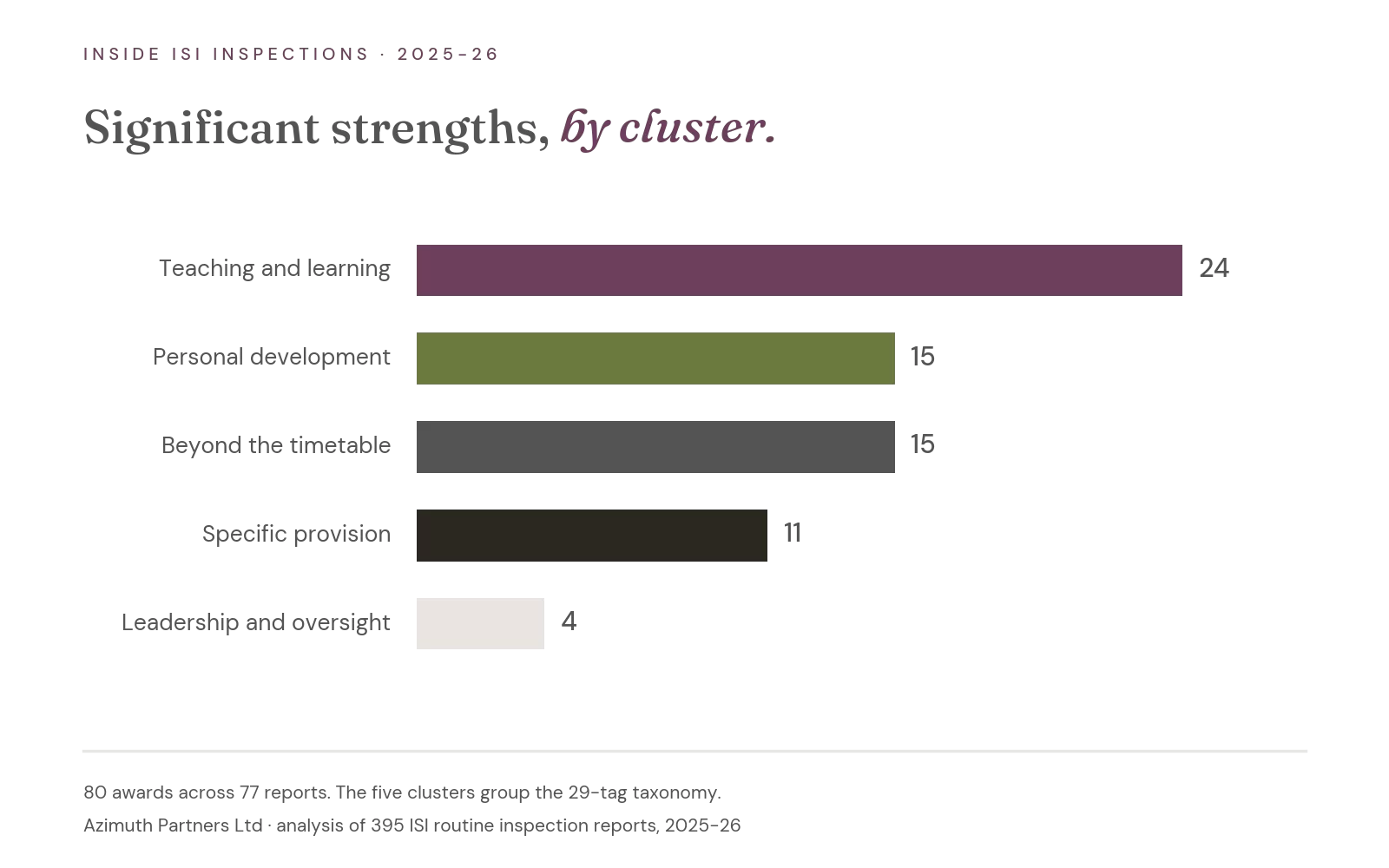
The corpus shows where such practice tends to live. The accolade clusters around teaching and learning (24 awards), personal development (15), school life beyond the timetable (15), provision for specific cohorts such as SEND, early years and boarding (11), and leadership and oversight (4). Curriculum design, character, co-curricular reach, carefully tailored support. The everyday substance of a school, done unusually well and unusually deliberately.
However, nowhere in the 395 reports is a significant strength awarded for exam results or university destinations. One accolade for pupils’ academic outcomes comes closest, and it stands out precisely because it is so unusual. The measures that fill league tables and prospectus covers are the ones ISI’s rarest praise usually looks past.
That should change how a leadership team approaches this whole subject. ISI seems less focused on what can be measured on a spreadsheet and more on that which tells a story: a curriculum with an explicit rationale, pupils whose self-knowledge is beyond their age, a co-curricular programme that every child genuinely experiences positively. If you want the accolade, your school’s focus should be on crafting a story that becomes the lived reality, and then making sure your whole community can tell the story.
One item on the agenda
The practical move is available to any SLT this term, and it costs one agenda item. My Inside ISI Inspections Full Report’s own discussion prompt puts it plainly: “What would it take for our school to receive a ‘significant strength’, and which specific practice would most plausibly attract it? What is the gap between current practice and the practice that would warrant the accolade?” Answer that honestly, choose your one thing (once the registers and policies have had their audit), and spend the years between inspections closing the gap in plain sight of your pupils, your parents and your staff.
What will the future hold?
Today’s consultation may remove the label from future frameworks. If it does, remarkably little of the above changes. The three tests describe what exceptional practice looks like whether or not a reporting mechanism gives it a name. The no-signposting principle is simply a description of how inspection sees a school: through its pupils, its parents and its everyday practice rather than through its pitch. And the discipline of choosing one strength and making it visible was never really about inspection. It is about school improvement, development planning and self-evaluation.
In a not too distant future an inspection team will sign in at your reception and collect their lanyards. Whether or not the framework still names significant strengths by then, if the work has been done nobody will need to say the word strength at all. By breaktime pupils will have shown them, teachers will have highlighted it, and the parent survey will be full of mentions of it. The product will have sold itself. No marketing campaign was ever required, just consistent focus and steady leadership.
The full analysis, Inside ISI Inspections, covering all 395 routine inspection reports from the 2025-26 cycle, is available here, where you can also download a free summary.
Featured image by Alan Aprilio on Unsplash