


Angine de Poitrine is a band from Saguenay, Quebec, that has recently taken the internet by storm, and I must admit I am mildly obsessed with their music and general existence, which I find both mesmerising and refreshing in equal measure.
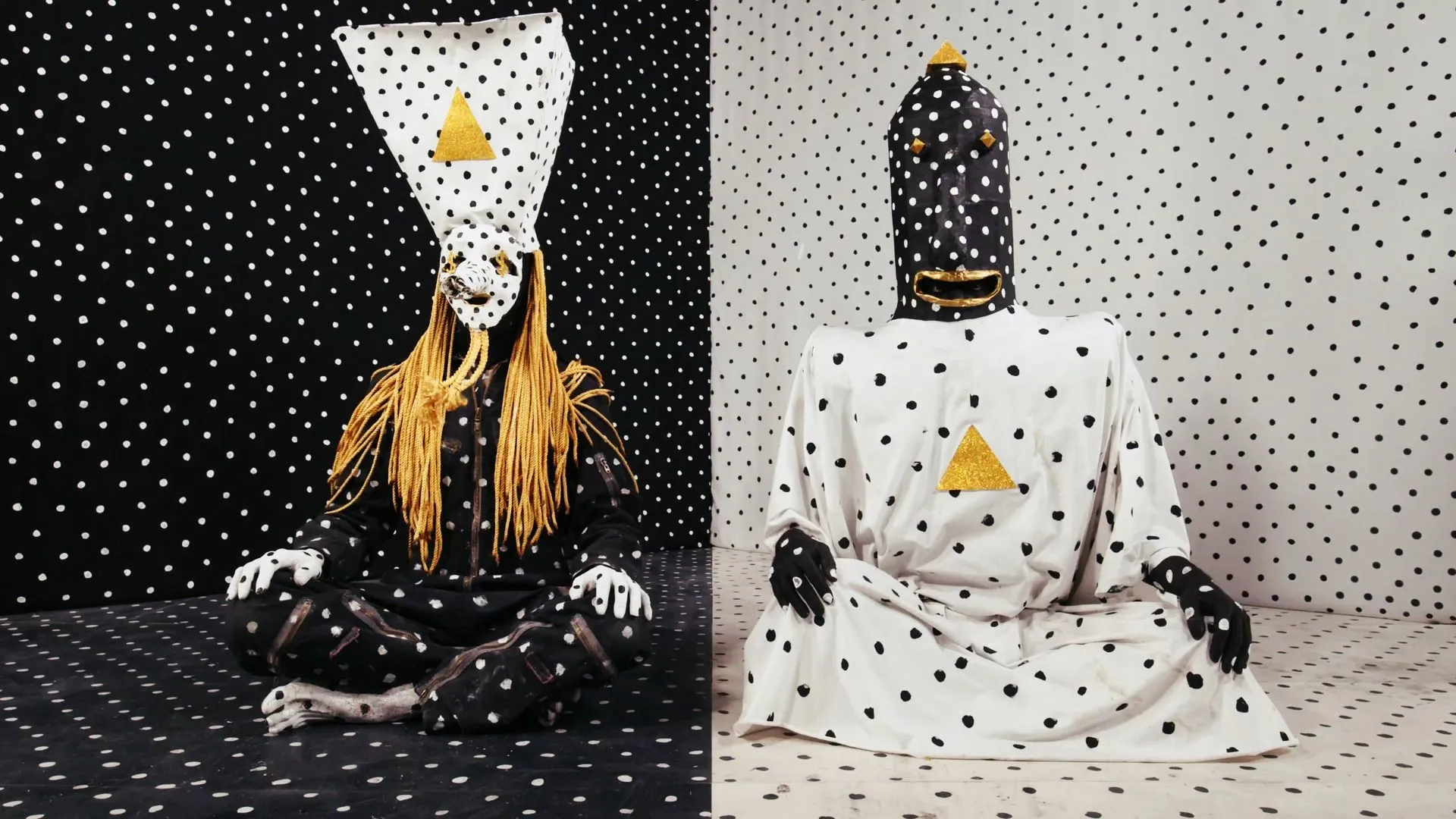
They are two musicians, Khn and Klek de Poitrine, who perform under papier-mâché masks with improbable elongated noses, dressed head to toe in black-and-white polka dots. Khn plays a custom double-necked guitar-bass, hand-built by a local luthier, fitted with extra frets to reach the notes that exist between the standard intervals of Western music. Klek plays drums. Together, and thanks to the skilful use of a loop machine, they sound like considerably more than two people on stage.
I have been thinking about them a great deal lately, and not only because I find their music remarkable. I have been thinking about what they represent: two humans doing something that a machine, however sophisticated, could not have conceived. That feels relevant right now, when we are all being invited to have opinions about artificial intelligence, and most of us, myself included, are generating considerably more heat than light.
The fog of too much certainty
The current conversation about AI in education has split, with predictable reliability, into two camps that I find equally unhelpful. On one side, the evangelists who see transformative disruption everywhere and treat scepticism as a failure of imagination. On the other, the resisters who see existential threat everywhere and treat enthusiasm as naivety. Both positions share a common flaw: they assume that how a technology appears in the infancy of its arrival is how it will permanently be.
History suggests otherwise.
What photography did to painting
At this point people usually refer to the printing press or to Socrates’s views on writing to illustrate how a technology is perceived versus its eventual impact. But let me use a different illustration. When photography was invented in the 1830s, the anxiety in artistic circles was immediate and, on the face of it, reasonable. Why commission a painted portrait when a photograph was faster, cheaper, and more accurate than any painter could achieve? Why render laboriously a bowl of fruit in oils when a camera would capture it in seconds?
But the death of painting did not materialise. Instead, freed from the obligation to reproduce what the eye could see, painters began to explore what the camera could not do. Impressionism broke apart the certainty of surfaces. Post-Impressionism pushed further into structure, emotion, and interior meaning. Gauguin sailed to Tahiti to find a palette that no camera had yet learned to feel. Picasso dismantled perspective entirely. The art form, confronted with a technology that could outperform it in one dimension, exploded into creativity and discovered what it was actually for.
What AI might clarify
There is something structurally similar happening now. The things that AI does well are, on reflection, the things we should probably be relieved to hand over: the formulaic, the repetitive, the competent execution of predictable tasks. Most commercial pop music is built on the same four chords in slightly different configurations. Generating more of it is well within the capability of current tools. The question this raises is not whether AI will produce music, but what that frees human musicians to pursue instead.
Angine de Poitrine answers that question by playing in the gaps. Microtonal music inhabits the intervals that Western scales do not formally recognise, shaped by years of listening to Turkish, Japanese, Arabic, and Indonesian music. It is, by definition, outside what a system optimised for pattern-recognition would generate. It is also, judging by five million views and sold-out venues, exactly what a growing audience is hungry for.
What this means for schools
In education, we are somewhere in the middle of this story, not yet at the point where the technology has settled into its actual purpose. There is still too much noise, too many conflicting claims about what AI will replace, enhance, or render obsolete. The more productive question is harder and more interesting than either camp tends to acknowledge. Not whether AI will change things, since it most definitely will, as all significant technologies do, but what that clarifies about what we are actually here to do.
That is not a question AI can answer for us. It requires something like microtonal thinking: the willingness to work in the gaps between established frameworks, to resist the pull of the familiar scale, to build something that does not immediately conform to what the system expects.
”The art form, confronted with a technology that could outperform it in one dimension, exploded into creativity and discovered what it was actually for.
The best teachers already do this. What they offer is not information delivery or assessment processing. It is what happens in a room when a skilled professional reads a group of young people and responds to what they actually need rather than what the lesson plan anticipated. That cannot be AI-generated. It is built over years, through experience and reflection, in precisely the way that Angine de Poitrine built their musical language: slowly, collaboratively, and in ways that would initially have seemed, to most observers, like an elaborate joke.
The infrastructure underneath
I think we can agree that effective technology, when the hype fades, becomes infrastructure. It recedes into the background and does its work without fuss, as electricity does, as writing and the printing press did, as photography eventually did. Technology did not kill off our humanity, it revealed it.
Angine de Poitrine began as a practical joke. Two musicians who wanted to play the same venue twice in a week put on masks so nobody would recognise them. The weird masks stayed and their music became something genuinely strange and original. Their identities remain unknown. What is known is that they have spent twenty years learning to play together, developing a language that sounds like nothing else.
That is, arguably, the appropriate response to a world in which AI is becoming very good at sounding like everything else. Not to compete on those terms. To say to the AI: I see your pattern recognition, and I raise you a polka-dotted papier-mâché mask.
Photo by Constantin Monfilliette
How digitally mature is your school?
Get a free, personalised report with priorities that are actually relevant to you.