


Thinking is the Work
In an age where information is instantaneous and answers are automated, the question is no longer whether pupils can find knowledge, but what they do with it once they have it.
As AI tools increasingly offer the illusion of thinking without the effort, we must remain vigilant against the creeping erosion of human cognitive work. Cognitive offloading, a helpful strategy for freeing up mental bandwidth, can, when overused or uncritical, become a kind of intellectual leasehold. Students access knowledge only temporarily and superficially. Without the effort of generative thinking (retrieving, connecting, questioning…) they never truly come to own it. Knowledge remains the asset of others, and they remain the tenants, rather than the landlords of understanding.
The classroom, then, must remain a place where thinking is not outsourced, but exercised. A space where knowledge is not merely acquired but applied, questioned, and woven into webs of meaning. This resource explores how teachers can structure learning so that pupils think more, not less. It champions thinking that produces, secures, explores, and connects; that builds both understanding and the mental architecture to retain it.
What is Generative thinking?
Generative thinking is less about getting the answers right and more about engaging with the process. It involves making connections, uncovering insights, and constructing meaning. It thrives on well-crafted questions, purposeful silences, and structured opportunities for pupils to make sense of knowledge on their own terms, before encountering the perspectives of others.
In this light, generative thinking offers an alternative to doing the thinking for students. It is not enough to tell them what to know or even what to think, but rather we should design learning that teaches them how to think deliberately, independently, and well.
Why Questions Matter
This mindset applies just as much to our questioning as to any other aspect of teaching. Poor questions elicit compliance — short answers, safe guesses, allow minds to disengage. Better questions spark thought. They invite students into the learning rather than simply checking whether they’re paying attention.
The difference lies not in charisma or flair, but in careful, intentional design. These strategies are not about performance, but about creating the conditions for thinking. They can be learned, practised, and adapted to suit any teaching style. Thoughtful questioning should not the preserve of the naturally eloquent or confident; it is rather a craft, grounded in purpose and shaped through reflection, that everyone can develop.
Low-quality questioning:
- Puts the teacher at the centre.
- Rewards speed over reflection.
- Reinforces surface-level knowledge.
High-quality questioning:
- Pauses to allow thinking time.
- Signals that struggle is expected.
- Explores misconceptions rather than correcting them too quickly.
- Positions pupils as thinkers, not just answerers.
This first table aligns questioning strategies with cognitive focus, instructional intent, and example questions (or prompts).
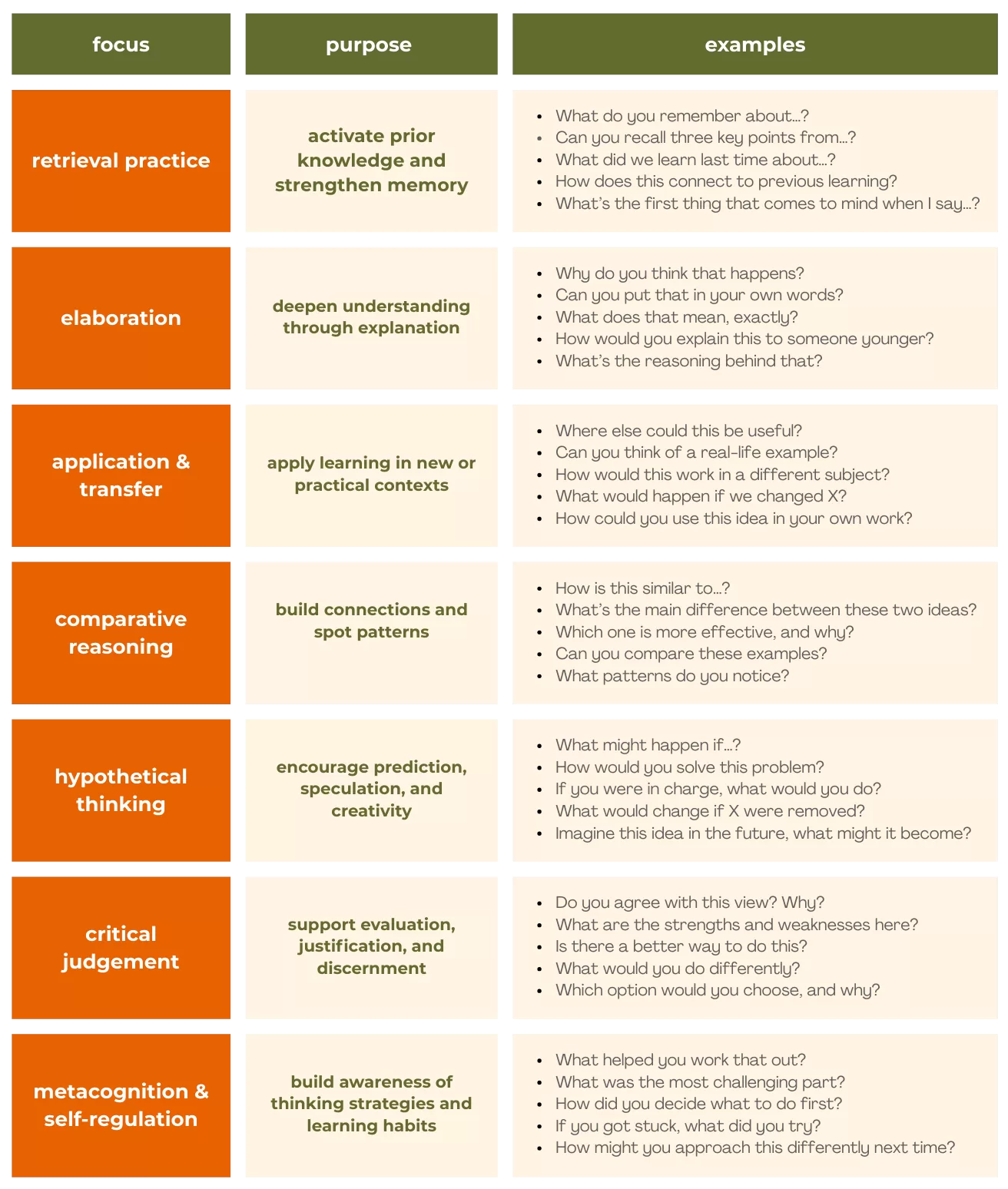
This second table reframes questions for deeper thinking:

Making Thinking Visible
If thinking is the work, then we must create routines that reveal and reward it. Here are five key strategies to promote generative thinking in the classroom:
1. Pose, Pause, Pounce, Bounce
A familiar strategy, but underused. Pose a good question. Pause. Then pounce by selecting a student, not one who raises a hand. Then bounce by inviting others to reflect or build on the first response.
Why it works: It disrupts the guess-the-answer game and promotes a culture of attentive, extended thought.
2. Cold Calling with Warmth
Cold calling should not be confrontational; it should be invitational. When done well, it signals that everyone’s voice matters, and that everyone’s thinking is expected.
Pro tip: Always follow cold calling with coaching-style quesitons: “What made you say that?”, “What led you to that conclusion?”, “What else”? This turns answers into thinking pathways.
3. Reframing the Question
When students struggle, don’t simplify the question, reframe it instead. Make the cognitive load manageable, not minimal.
Instead of: “What’s the answer?”
Try: “What do you notice?” or “What would happen if…?”
This preserves rigour while scaffolding entry into the task.
4. Thinking Aloud Allowed
Model your own metacognition. Let students hear what a thinker sounds like. Articulate confusion, decision-making, and evaluation.
“I’m wondering if this detail supports the argument… but I’m not sure yet.”
Such thinking routines signal that uncertainty is not a weakness but a stage in the process.
5. Wait Time & Think Time
Research has found that the average teacher wait time is under one second. Yet when wait time exceeds three seconds, student responses become more thoughtful and grounded. Try pairing this with “Think-Pair-Share” to encourage verbal rehearsal before public speaking.
A Culture of Thinking
Ultimately, generative thinking as an idea asks teachers to value process as much as product, struggle over speed, and depth over coverage. And it requires trust in students’ capacity to think, as well as trust in ourselves to let them.
It may feel slow. It may be more effortful. But that’s how learning happens.
The tables above can be downloaded as a pdf resource from here.
If these ideas resonated, consider exploring them further through tailored CPD or coaching-led professional learning.
Designed to be practical, reflective, and grounded in research, these sessions help schools embed good pedagogy and deeper thinking into everyday practice.
Get in touch”The teacher’s job is not to transmit knowledge, but to engineer effective learning environments for students.
— Dylan Wiliam
References and Further Reading
Downey, M., 2003. Effective coaching: Lessons from the coach’s coach. London: Texere.
Lemov, D., 2021. Teach like a champion 3.0: 63 techniques that put students on the path to college. San Francisco: Jossey-Bass.
Mccrea, P., 2020. Memorable teaching: Leveraging memory to build deep and durable learning in the classroom. Woodbridge: John Catt Educational.
Rosenshine, B., 2012. Principles of instruction: Research-based strategies that all teachers should know. American Educator, 36(1), pp.12–19.
Starr, J., 2021. The coaching manual: The definitive guide to the process, principles and skills of personal coaching. 5th ed. Harlow: Pearson.
Willingham, D.T., 2009. Why don’t students like school? A cognitive scientist answers questions about how the mind works and what it means for the classroom. San Francisco: Jossey-Bass.
Wiliam, D., 2018. Creating the schools our children need: Why what we’re doing now won’t help much (and what we can do instead). West Palm Beach: Learning Sciences International.




Join the discussion 2 Comments